
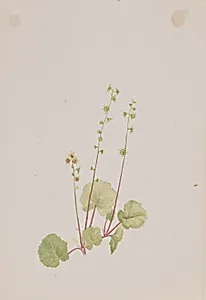
Mitella nuda
ca. 1900-1920
Medium
Painting
Classification
Painting
Department
Smithsonian Collection
Museum
Smithsonian American Art Museum
Credit
Smithsonian American Art Museum, Gift of the artist
Accession Number
1970.355.73
Rights
Public Domain
Tags
Art Historical Context
Mary Vaux Walcott'sMitella nuda*, created around 1900-1920, captures the delicate beauty of the naked bishop's cap flower, a native North American wildflower known for its fragile, fringed petals. This painting, gifted by the artist to the Smithsonian American Art Museum exemplifies Walcott's passion for botanical illustration during an era when scientific documentation blended artistry with natural history exploration. Walcott, a pioneering female artist and naturalist, produced meticulous studies of alpine flora during expeditions in the Canadian Rockies alongside her husband, paleontologist Charles Doolittle Walcott. Her works, rendered in painting medium with precise detail, contributed to early 20th-century efforts to catalog and preserve America's biodiversity. Published in her acclaimed 1925 portfolio *North American Wild Flowers*, these illustrations bridged art and science, influencing botanical art traditions. Housed in the Smithsonian's collection, *Mitella nuda* invites visitors to appreciate not just the flower's ethereal form but Walcott's enduring legacy as a trailblazing documentarian of the natural world, reminding us of the intersection between observation, beauty, and conservation.