
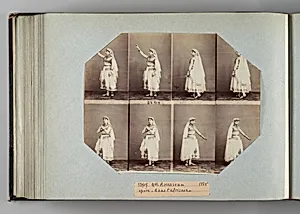
Mlle Rousseau dans l'Africaine
Medium
Albumen silver print from glass negative
Dimensions
Image: 7 3/8 × 9 1/4 in. (18.8 × 23.5 cm) Album page: 10 3/8 × 13 3/4 in. (26.3 × 35 cm)
Classification
Photographs
Department
Photographs
Museum
Metropolitan Museum of Art, New York, NY
Credit
Gilman Collection, Gift of The Howard Gilman Foundation, 2005
Accession Number
2005.100.588.1.90
Rights
Public Domain
Art Historical Context
In 1865, French photographer André-Adolpheugène Disdéri *Mlle Rousseau dans l'Africaine*, an albumen silver print from a glass negative that immortalizes the performer Mlle. Rousseau in costume from Giacomo Meyerbeer's grand opera *L'Africaine*. Premiered that same year in Paris, opera's exotic tale of love and adventure in 16th-century Portugal and India enthralled audiences, and Disdéri's image reflects the era's fascination with theatrical stardom. Measuring about 7⅜ × 9¼ inches, this photograph likely originated as a *carte de visite*—a pocket-sized portrait format Disdéri himself invented in 1854, sparking a collecting frenzy akin to modern trading cards for celebrities. Disdéri's mastery of the wet-collodion process on glass negatives produced remarkably sharp, detailed images, with the albumen coating yielding rich tones and fine gradations. This technique was pivotal in elevating photography from novelty to art, especially for documenting the performing arts. As part of the Metropolitan Museum of Art's Gilman Collection, the print highlights how 19th-century photography bridged visual culture and popular entertainment, preserving fleeting moments of cultural splendor for posterity. (198 words)
About the Artist
André-Adolphe-Eugène Disdéri · 1819–1889
**André-Adolphe-Eugène Disdéri** (1819–1889) was a pioneering French photographer whose innovations transformed portraiture into a mass medium during the Second Empire. Born on March 28, 1819, in Paris, Disdéri pursued diverse careers in commerce, acting, and politics early on, while studying art amid personal hardships following his father's death, which compelled him to support his mother, sibli...