
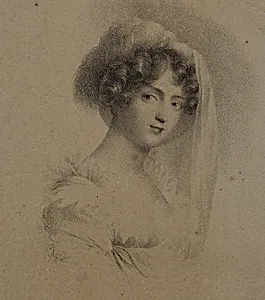
Mme. Horace Vernet
Medium
Lithograph in black on tan China paper, laid down on ivory wove paper
Dimensions
Image: 13 × 9.8 cm (5 1/8 × 3 7/8 in.); Primary support: 14.5 × 12.4 cm (5 3/4 × 4 15/16 in.); Secondary support: 34.8 × 26 cm (13 3/4 × 10 1/4 in.)
Classification
lithograph
Department
Prints and Drawings
Museum
Art Institute of Chicago
Accession Number
9579
Rights
Public Domain
Art Historical Context
Jean-Baptiste Isabey’s 1818 lithograph captures Mme. Horace Vernet with quiet elegance. A leading French portraitist known for his refined miniatures, Isabey turned to the newly invented medium of lithography to create intimate images of notable figures. The sitter, wife of the rising painter Horace Vernet, is presented in a delicate bust-length view that emphasizes grace and composure. This print belongs to the earliest phase of lithography, a technique invented in the 1790s that allowed artists to draw freely on stone. Isabey printed the image in black on fine tan China paper, a support prized for its smooth surface and ability to hold subtle tonal effects. The modest scale and careful layering onto a secondary sheet reflect the experimental care given to these early lithographs. Created during the Bourbon Restoration, the work offers a glimpse into the artistic and social circles of post-Napoleonic Paris. Isabey’s sensitive handling helped establish lithography as a respected art form rather than merely a reproductive tool, paving the way for its later flowering in French printmaking.
About the Artist
Jean-Baptiste Isabey · 1767–1855
Jean-Baptiste Isabey (1767–1855) was a French painter and miniaturist whose extraordinary longevity and adaptability allowed him to serve as the preeminent portraitist of successive French regimes — from the court of Louis XVI through the Revolution, the Napoleonic Empire, the Restoration, and into the July Monarchy — making his career an almost unparalleled chronicle of French political and socia...