
Mock Joust of War with Fixed Shields
c.1512-1515
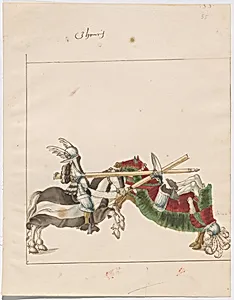
Medium
pen and brown ink with watercolor over black chalk and leadpoint on laid paper
Dimensions
sheet: 33.7 × 26.3 cm (13 1/4 × 10 3/8 in.)
Classification
Drawing
Department
CG-E
Museum
National Gallery of Art, Washington, D.C.
Credit
Rosenwald Collection
Accession Number
1943.3.4459
Rights
Public Domain
Art Historical Context
### Mock Joust of War with Shields This lively drawing, created by an anonymous German artist around 1512-1515, captures the spirited energy of a mock jou—a playful tournament variant where shields are fixed in place, allowing riders to charge without the full peril of real combat. Rendered on laid paper, the sheet measures 33.7 26.3 cm and depicts armored figures on horseback clashing amid a crowd, evoking the chivalric spectacles popular in the Holy Roman Empire during the early Renaissance. Such scenes reflect the era's fascination with knightly traditions, blending pageantry with martial training. The artwork's mixed media—leadpoint and black chalk for precise underdrawings, followed by fluid pen and brown ink lines, and subtle watercolor washes—showcases Northern European draftsmanship techniques. These methods allowed artists to plan compositions for larger works like prints or paintings, highlighting the drawing's preparatory role and its rarity as a preserved 16th-century sketch. Housed in the National Gallery of Art's Rosenwald Collection (Department CG-E), this piece offers a window into Renaissance court culture, where mock jousts entertained nobility and reinforced ideals of valor. Its detailed observation of movement and attire makes it a gem for understanding everyday chivalric life.
About the Artist
German 16th Century · 1500–1600
The designation "German 16th Century" refers to a collective of anonymous artists active during the height of the German Renaissance, a period marked by profound artistic innovation amid the Protestant Reformation and humanist revival. Little is known about the individual lives or training of these makers, as their identities remain undocumented, with works often attributed based on regional style...