
Model standing
June 1902
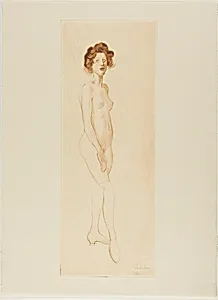
Medium
Soft ground etching, aquatint and drypoint from a zinc plate in bistre (brown) on ivory wove paper
Dimensions
Image/plate: 39.5 × 14.8 cm (15 9/16 × 5 7/8 in.); Sheet: 45.2 × 33.1 cm (17 13/16 × 13 1/16 in.)
Classification
etching
Department
Prints and Drawings
Museum
Art Institute of Chicago
Accession Number
49888
Rights
Public Domain
Art Historical Context
Théophile-Alexandrelen, a Swiss-born who thrived in fin-de-siècle Paris, captured the human form with empathy and realism in *Model Standing* (June 1902). Renowned for his posters, illustrations, and prints depicting Parisian working-class life, Steinlen here presents a poised female figure, likely a life-study model, rendered in a soft ground etching, aquatint, andpoint on a zinc plate. Printed in warm bistre ink on ivoryove paper (39.5 × 14.8 cm image), this intimate work reflects his mastery of mixed techniques during the Belle Époque, a time when printmaking bridged fine art and mass media. Steinlen's process combined soft ground etching for delicate textures, aquatint for subtle tonal gradations mimicking wash drawings, and drypoint for expressive, velvety lines created by burr buildup. Using zinc—a durable alternative to copper—allowed for finer details and multiple impressions, democratizing access to his art. Housed in the Art Institute of Chicago's Prints and Drawings collection, this piece exemplifies how Steinlen elevated everyday subjects, blending Art Nouveau elegance with social observation. Visitors will appreciate its technical virtuosity: the bistre hue evokes sepia photographs, while the standing model's contemplative stance invites reflection on the artist's studio life amid early 20th-century modernism. A testament to printmaking's evolution, it remains a gem for admirers of nuanced portraiture.
About the Artist
Théophile-Alexandre Pierre Steinlen · 1859–1923
Théophile Alexandre Steinlen, born on November 10, 1859, in Lausanne, Switzerland, grew up in an environment steeped in artistic influence, with his grandfather serving as a drawing teacher in nearby Vevey. He studied literature at the University of Lausanne before working as a designer trainee in a Mulhouse textile mill. In his early twenties, around 1881, Steinlen married Émilie Mey, and the cou...