
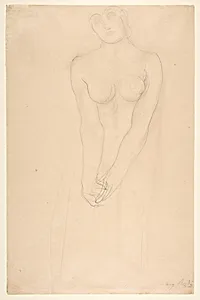
Nude female figure standing with clasped hands
n.d.
Medium
Graphite on cream paper
Dimensions
Overall: 14 1/8 x 9 1/16 in. (35.9 x 23 cm)
Classification
Drawings
Department
Drawings and Prints
Museum
Metropolitan Museum of Art, New York, NY
Credit
Gift of Thomas F. Ryan, 1913
Accession Number
13.164.5
Rights
Public Domain
Tags
Art Historical Context
In the intimate world of Auguste Rodin's drawings, *Nude Female Figure Standing with Clasped Hands* captures the sculptor's profound fascination with the human form. Created in graphite on cream paper around the late 19th or 20th century (date unknown), this 14 1/8 x 9 1/16-inch sheet exemplifies Rodin's mastery of preparatory sketches. As a leading figure in modern sculpture—known for iconic works like *The Think* and *The Gates of Hell*—Rod produced thousands of drawings, often as private studies that explored anatomy, movement, and emotion with fluid, expressive lines. The clasped hands of the standing nude convey a sense of quiet introspection or vulnerability, a recurring motif in Rodin's female figures that bridged classical idealism with raw, modern realism. Graphite's soft tonal range allowed him to model the body's volumes sculpturally on paper, mimicking the three-dimensionality of his bronzes and marbles. This technique highlights his innovative approach, blending observation from life with imaginative invention. Now housed in the Metropolitan Museum of Art's Drawings and Prints department, thanks to a 1913 gift from Thomas F. Ryan, the work invites visitors to glimpse Rodin's studio process. It underscores the cultural shift toward celebrating the nude as a vehicle for psychological depth, making it a gem for admirers of his sensual, humanistic vision.
About the Artist
Auguste Rodin · 1840–1917
François Auguste René Rodin (1840-1917) stands as the founder of modern sculpture, transforming the art form from academic tradition into expressive modernism. Born into a working-class Parisian family, Rodin faced early rejection, failing three times to gain admission to the prestigious École des Beaux-Arts. This setback forced him to work as a craftsman for nearly two decades, though his 1875 tr...