
Modern Bucolic
Medium
Woodcut in peach, fawn, brown, olive-brown and red-brown on cream laid paper
Dimensions
Image/plate: 26.3 × 29.1 cm (10 3/8 × 11 1/2 in.); Sheet: 36.2 × 47 cm (14 5/16 × 18 9/16 in.)
Classification
woodcut
Department
Prints and Drawings
Museum
Art Institute of Chicago
Accession Number
11620
Rights
Public Domain
Art Historical Context
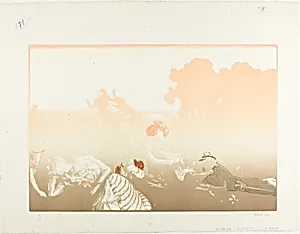
**Modern Bucolic** (1901) by Louis Lepère captures the charm of rural life through a masterful color woodcut, printed in peach, fawn,, olive-brown, and-brown inks on cream laid paper. 26.3 × 29.1 cm, this intimate print from the Art Institute of Chicago Prints and Drawings collection showcases Lepère's expertise as a leading French printmaker of the Belle Époque. The title evokes a "modernolic"—an idyllic pastoral scene reimagined with contemporary flair, blending nostalgia for the countryside with innovative artistry. Lepère, a pioneer in reviving the woodcut medium in late 19th-century France, drew inspiration from Japanese ukiyo-e prints, employing multiple woodblocks to layer subtle, earthy tones that mimic the textures of nature. This technique allowed for rich, atmospheric effects, where the creamy paper enhances the warmth of the palette. Woodcuts, traditionally black-and-white, gained new vibrancy through his color innovations, bridging traditional craftsmanship with modern aesthetics. Housed in a prestigious collection, *Modern Bucolic* exemplifies Lepère's contribution to the Japonisme movement, offering visitors a window into how turn-of-the-century artists infused everyday scenes with poetic depth. Its enduring appeal lies in celebrating simplicity amid rapid urbanization, inviting us to pause and appreciate the timeless beauty of the land. (198 words)
About the Artist
Louis Auguste Lepère · 1849–1918
Louis-Auguste Lepère (1849–1918) was born in Paris on November 30 to the sculptor François Lepère, immersing him early in the artistic world. At age thirteen, he apprenticed in the studio of the English wood engraver Joseph Burn-Smeeton, training there from 1862 to 1867, and later attended drawing courses under Horace Lecoq de Boisbaudran at the Petite École (now École nationale supérieure des art...