
Modern Bucolic
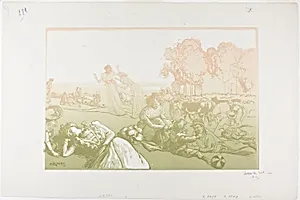
Medium
Woodcut in olive, fawn and salmon from two blocks on cream laid paper
Dimensions
Image: 36.2 × 39.5 cm (14 5/16 × 15 9/16 in.); Sheet: 36.4 × 54.9 cm (14 3/8 × 21 5/8 in.)
Classification
woodcut
Department
Prints and Drawings
Museum
Art Institute of Chicago
Accession Number
11626
Rights
Public Domain
Art Historical Context
**Modern Bucolic** (1901) by Louis Auguste Lepère captures a serene pastoral scene through the lens of early 20th-century French printmaking. Lepère, a master engraver and illustrator active in Paris, drew inspiration from nature and everyday rural life, blending traditional European techniques with the bold influences of Japanese woodblock prints—a hallmark of the Japonisme movement sweeping Europe at the fin de siècle. This woodcut, housed in the Art Institute of Chicago's Prints and Drawings department, measures an impressive 36.2 × 39.5 cm, its cream laid paper providing a warm backdrop for the artwork's subtle hues. Printed from just two blocks in olive, fawn, and salmon tones, the piece exemplifies Lepère's innovative approach to color woodcuts. Unlike monochromatic engravings common in his era, this multi-block method allowed precise layering of earthy colors, evoking the soft light and textures of a modern countryside. Woodcuts, carved in relief and hand-printed, demand meticulous craftsmanship, highlighting Lepère's skill in translating bucolic tranquility—think shepherds, fields, and gentle landscapes—into a "modern" idiom that feels both timeless and contemporary. As a snapshot of 1901 Paris's artistic revival, *Modern Bucolic* reflects a cultural shift toward accessible, decorative prints amid the Art Nouveau era. Visitors will appreciate its tactile quality and harmonious palette, inviting a moment of peaceful reflection in our virtual galleries.
About the Artist
Louis Auguste Lepère · 1849–1918
Louis-Auguste Lepère (1849–1918) was born in Paris on November 30 to the sculptor François Lepère, immersing him early in the artistic world. At age thirteen, he apprenticed in the studio of the English wood engraver Joseph Burn-Smeeton, training there from 1862 to 1867, and later attended drawing courses under Horace Lecoq de Boisbaudran at the Petite École (now École nationale supérieure des art...