
Mohammed and the Monk Sergius
1508
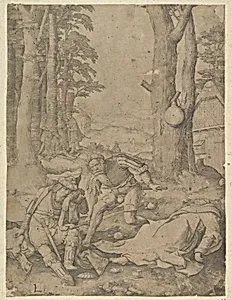
Medium
Engraving; second state
Dimensions
sheet: 11 1/4 x 8 3/8 in. (28.6 x 21.3 cm)
Classification
Prints
Department
Drawings and Prints
Museum
Metropolitan Museum of Art, New York, NY
Credit
Gift of Harry G. Friedman, 1962
Accession Number
62.635.117
Rights
Public Domain
Tags
Art Historical Context
**Mohammed and the Monk Serg** is an early engraving by Lucas van Leyden a Dutch prodigy of the Northern Renaissance born in 1494. in 1508 when the artist was just 14 this second-state impression measures 11¼ × 8⅜ inches and exemplifies van Leyden's precocious mastery of the burin. His intricate line work captures a narrative scene amid a detailed landscape, featuring men, trees, and monks—hallmarks of his style influenced by Albrecht Dürer yet distinctly Northern European in its crisp clarity and atmospheric depth. The title refers to a medieval Christian legend portraying the monk Sergius (often linked to Bahira) in a pivotal encounter with Mohammed, reflecting early 16th-century European views on Islam's origins amid religious tensions. Van Leyden's engraving technique, involving etching fine lines into a copper plate for multiple impressions, allowed widespread dissemination of such stories, blending moral allegory with vivid storytelling. Housed in the Metropolitan Museum of Art's Drawings and Prints department (gift of Harry G. Friedman, 1962), this work highlights van Leyden's rapid rise as one of the era's finest printmakers, bridging Gothic detail and emerging Renaissance naturalism for audiences hungry for portable art.
About the Artist
Lucas van Leyden · 1484–1533
Lucas van Leyden (1494–1533) was a Dutch painter and printmaker who stands among the greatest engravers of the Northern Renaissance. Born in Leiden as either Lucas Hugensz or Lucas Jacobsz, he lived and worked primarily in his native city, achieving international renown that rivaled the German master Albrecht Dürer. Lucas van Leyden revolutionized Netherlandish printmaking and was among the first...