
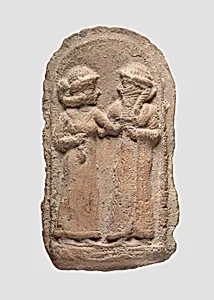
Molded plaque: couple
Unknown Artist
ca. 2000–1700 BCE
Medium
Ceramic
Dimensions
5 1/16 × 2 7/8 × 7/8 in. (12.9 × 7.3 × 2.2 cm)
Classification
Ceramics-Reliefs
Culture & Period
Isin-Larsa–Old Babylonian · Isin-Larsa–early Old Babylonian
Department
Ancient Near Eastern Art
Museum
Metropolitan Museum of Art, New York, NY
Credit
Rogers Fund, 1932
Accession Number
32.39.1
Rights
Public Domain
Tags
Art Historical Context
This charming molded ceramic plaque, depicting a couple, hails from the Isin-Larsa to early Old Babylonian period (. 2000–1700 BCE) in ancient Mesopotamia, now housed in the Metropolitan Museum of Art's Department Ancient Near Eastern Art. Measuring just over 5 inches tall, this intimate relief captures a moment of human connection from a time when southern Iraqi city-states like Isin Larsa flourished amid political rivalries and cultural innovation, just before the rise of Hammabi's Babylonian empire. Crafted in ceramic—a durable, everyday medium—the plaque was likely produced using a mold, allowing for multiple copies of such scenes. This technique democratized art, making it accessible beyond elite temples for use in homes, perhaps as protective talismans or symbols of fertility and marital harmony. Common in domestic contexts, these reliefs reflect the Mesopotamians' blend of daily life and spirituality, where couples embodied prosperity and continuity. Acquired through the Rogers Fund in 1932, this artifact offers a poignant glimpse into the social values of an ancient civilization, reminding us how small objects can illuminate profound cultural priorities.