
Mona
1911
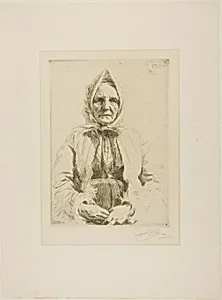
Medium
Etching on ivory laid paper
Dimensions
Image/plate: 24.9 × 17.9 cm (9 13/16 × 7 1/16 in.); Sheet: 43.9 × 32.8 cm (17 5/16 × 12 15/16 in.)
Classification
etching
Department
Prints and Drawings
Museum
Art Institute of Chicago
Accession Number
94618
Rights
Public Domain
Art Historical Context
Anders Zorn's *Mona* (1911) is a masterful etching on ivory laid paper, showcasing the Swedish artist's unparalleled skill in printmaking. Measuring 24.9 × 17.9 cm for the image and plate, with a larger sheet of 43.9 × 32.8 cm, this work resides in the Art Institute of Chicago's Prints and Drawings. Zorn, a leading figure in late 19th- and early 20th-century European art, was renowned for his portraits and nudes, often rendered with a realist's precision and an impressionist's sensitivity to light and texture. ching, Zorn's favored medium here, involves incising lines into a metal plate with acid, allowing for intricate detail and tonal subtlety—hallmarks of his technique. The ivory laid paper enhances the print's luminosity, giving *Mona* a delicate, almost luminous quality that draws viewers into its intimate portraiture. Created at the height of Zorn's career, when he was celebrated internationally for bridging painting and printmaking, this piece exemplifies his ability to capture human form with fluid lines and atmospheric depth. Housed among the museum's distinguished collection, *Mona* invites contemplation of Zorn's enduring legacy: a bridge between Scandinavian realism and global modernism. Its technical finesse makes it a gem for print enthusiasts, revealing how everyday materials could yield extraordinary emotional resonance.
About the Artist
Anders Zorn · 1860–1920
Anders Zorn (1860–1920), one of Sweden's most celebrated artists, was born on February 18 in Utmeland near Mora in Dalarna, and raised on his maternal grandparents' farm in the nearby hamlet of Yvraden. Displaying prodigious talent from a young age, he attended school in Mora Strand until age twelve, followed by secondary grammar school in Enköping, where he excelled in drawing people and horses. ...