
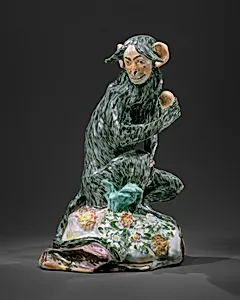
Monkey
ca.1740, after a model of ca.1732
Medium
Hard-paste porcelain
Dimensions
Height: 9 1/2 in. (24.1 cm)
Classification
Ceramics-Porcelain
Culture
German, Meissen
Department
European Sculpture and Decorative Arts
Museum
Metropolitan Museum of Art, New York, NY
Credit
The Jack and Belle Linsky Collection, 1982
Accession Number
1982.60.310
Rights
Public Domain
Tags
Art Historical Context
This delightful porcelain figurine, titled *Monkey*, exemplifies the rococo whimsy of mid-18th-century Meissen porcelain. Modeled by Johann Joachim Kler, the chief sculptor at the Meissen Manufactory, it dates to around 1740, based on a design from circa 1732. Standing at 9½ inches (24.1 cm) tall, the piece is crafted from hard-paste porcelain groundbreaking European innovation developed by Meissen in 1710, which rivaled the finest Chinese wares in translucency and durability. ändler, who joined Meissen in 1731, revolutionized porcelain sculpture with his lively, naturalistic animal figures, often infused with playful expressions and dynamic poses. Monkeys like this one were highly prized in aristocratic collections, symbolizing exoticism and lighthearted folly amid the opulent rococo style. The manufactory's secret formula for hard-paste porcelain allowed for intricate modeling and vivid overglaze enameling, capturing fur textures and mischievous details with astonishing precision. Housed in the Metropolitan Museum of Art as part of The Jack and Belle Linsky Collection (1982), this *Monkey* invites visitors to appreciate Meissen's pivotal role in elevating ceramics to high art, blending technical mastery with joyful imagination.