
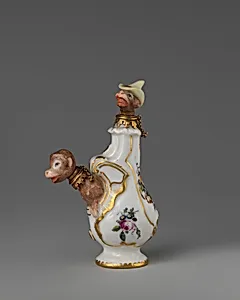
Monkeys within vase
ca. 1755
Medium
Soft-paste porcelain
Dimensions
3 × 1 7/8 in. (7.6 × 4.8 cm)
Classification
Ceramics-Porcelain
Culture
British, Chelsea
Department
European Sculpture and Decorative Arts
Museum
Metropolitan Museum of Art, New York, NY
Credit
Gift of Irwin Untermyer, 1964
Accession Number
64.101.538a–c
Rights
Public Domain
Tags
Art Historical Context
Nestled within the playful world of 18th-century British porcelain, *Monkeys within Vase* (ca. 1755) is a delightful creation from the Chelsea Porcelain Manufactory, one of England's pioneering ceramic workshops. Crafted from soft-paste porcelain—a glassy, translucent material blending clay with ground glass frit—this diminutive piece measures just 3 × 1 7/8 inches, perfect for adorning a gentleman's cabinet or lady's dressing table. Chelsea's soft-paste technique allowed for intricate modeling and vibrant enameling, mimicking the prized hard-paste porcelain of Meissen and Chinese imports while showcasing British ingenuity during the mid-Georgian era. This whimsical figurine captures the Rococo spirit of the time, with its lively monkeys and floral motifs evoking nature's exuberance. Monkeys, a recurring Chelsea favorite, symbolized exotic curiosity and lighthearted mischief, often depicted in human-like poses amid blooming flowers. Produced during Chelsea's "gold anchor" period (c. 1752–56), when the factory reached artistic heights under Nicholas Sprimont's direction, such pieces reflected the elite's taste for ornate, fantastical decor amid Europe's porcelain fever. Today, housed in The Metropolitan Museum of Art as a gift from Irwin Untermyer (1964), *Monkeys within Vase* exemplifies how ceramics bridged art and luxury, inviting us to smile at its cheeky charm while appreciating the technical finesse of early industrial-age craftsmanship.
About the Artist
Chelsea Porcelain Manufactory · 1744–1784
**Chelsea Porcelain Manufactory** The Chelsea Porcelain Manufactory, Britain's pioneering porcelain enterprise, was founded around 1743 in Chelsea, London, by two Huguenot silversmiths: Nicholas Sprimont from Liège and Charles Gouyn. Sprimont, trained in Paris as a goldsmith before immigrating to England, brought his expertise in luxury metalwork to the venture, while Gouyn handled early sales th...