
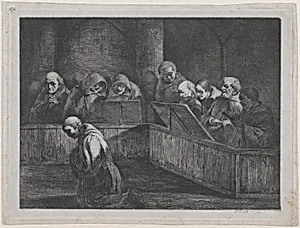
Monks Chanting
Medium
Etching with drypoint; third state of three
Dimensions
Sheet: 8 1/4 × 10 15/16 in. (21 × 27.8 cm) Plate: 7 1/2 × 10 1/2 in. (19 × 26.6 cm)
Classification
Prints
Department
Drawings and Prints
Museum
Metropolitan Museum of Art, New York, NY
Credit
Gift of Mrs. Algernon S. Sullivan, 1919
Accession Number
19.56.59
Rights
Public Domain
Tags
Art Historical Context
In the hushed corridors of the Metropolitan Museum of's Drawings and Prints department, Jean-Jacques de Boissieu's *Monks Chanting*1795) captures a moment of serene devotion. This etching with drypoint, in its third and final state of three, measures a modest 8 1/4 × 10 15/16 inches on the sheet. De Boissieu, a French printmaker active during the turbulent French Revolution, was renowned for his meticulous technique, blending the precision of etching—where acid etches lines into a copper plate—with the soft, velvety burr of drypoint, evoking the intimacy of a drawing. The scene depicts monks gathered in chant, their robes and arched architecture suggesting a cloistered ritual amid Gothic shadows. This third state likely reveals the artist's final refinements, with enriched tones and textures that heighten the print's atmospheric depth, a nod to Rembrandt's influence on 18th-century etchers. Created just after the Revolution's de-Christianization campaigns, the work subtly contrasts revolutionary upheaval with timeless spiritual harmony. A generous gift to the Met from Mrs. Algernon S. Sullivan in 1919, *Monks Chanting* invites visitors to ponder faith's endurance, its intricate lines whispering across centuries.
About the Artist
Jean Jacques de Boissieu · 1736–1810
French, Lyons 1736–1810 Lyons