
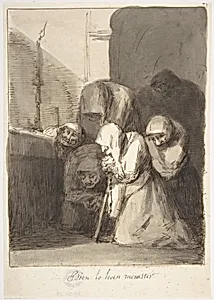
They Centainly Can Use It ("Bien lo han menester")
1807–45
Medium
Pen and dark brown ink on off-white paper. Composition outlined with pen and dark brown ink on all sides
Dimensions
7-1/4 x 5-1/8 in. (18.4 x 13.0 cm)
Classification
Drawings
Department
Drawings and Prints
Museum
Metropolitan Museum of Art, New York, NY
Credit
Dodge Fund, 1939
Accession Number
39.29.14
Rights
Public Domain
Tags
Art Historical Context
Leonardo Alenza y Nieto (1807–1845), a Spanish draftsman and painter active during the Romantic era, created this compact pen-and-ink drawing titled *They Certainly Can Use It* (“Bien lo han menester”). Working in the wake of Goya, Alenza often turned his sharp eye toward everyday Spanish life, using humor and social observation to comment on human needs and follies. The title itself suggests a scene of charity or ironic commentary, consistent with the artist’s interest in popular customs and moral themes. Executed in dark brown ink on off-white paper with a carefully ruled border, the drawing measures just over seven by five inches. This modest scale and linear technique allowed Alenza to capture expressive gestures and narrative detail with economical strokes, a method well suited to the spontaneous quality of 19th-century Spanish drawing. The work’s focus on women, noted in the museum’s records, underscores Alenza’s frequent attention to female figures within social contexts. Acquired by the Metropolitan Museum of Art through the Dodge Fund in 1939, the sheet now resides in the Department of Drawings and Prints. It offers visitors an intimate glimpse into Romantic-era Spain’s artistic dialogue between satire, empathy, and keen observation of daily life.
About the Artist
Leonardo Alenza y Nieto · 1807–1845
Leonardo Alenza y Nieto (1807–1845) was a Spanish painter and caricaturist whose brief life produced a body of work remarkable for its satirical wit, psychological penetration, and painterly freedom. Born in Madrid, he trained at the Real Academia de Bellas Artes de San Fernando, the preeminent institution for artistic education in Spain, where he absorbed the technical foundations of academic pai...