
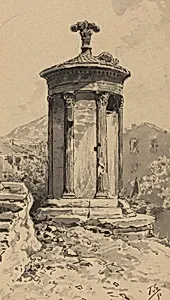
Monument of Lysicrates
Medium
pen and black ink and watercolor
Dimensions
Overall: 15.4 x 8.7 cm (6 1/16 x 3 7/16 in.) support: 48.8 x 33.7 cm (19 3/16 x 13 1/4 in.)
Classification
Drawing
Department
CG-E
Museum
National Gallery of Art, Washington, D.C.
Credit
Gift of Dr. Dieter Erich Meyer
Accession Number
1977.6.19
Rights
Public Domain
Art Historical Context
Nestled in the heart of Athens, the Monument of Lysicrates stands as one of ancient Greece's most charming survivals, built in 334 BC to honor a patron's victory in a dramatic choral contest. This exquisite 1890 drawing by German artist Themistocles von Eckenbrecher (1853–1932) captures its delicate Corinthian columns and ornate frieze with pen and black ink, heightened by watercolor washes. At just 15.4 x 8.7 cm, the intimate sheet—on a larger support—suggests a traveler's sketch, likely made during von Eckenbrecher's journeys through the Mediterranean, where he specialized in luminous landscapes and architectural studies. Von Eckenbrecher's technique shines in the precise ink lines delineating the monument's sculptural details—tripods and theatrical scenes—while soft watercolors evoke weathered stone under Athenian light. Created amid 19th-century Europe's archaeological fervor, the work reflects Romantic fascination with classical antiquity, bridging ancient glory and modern rediscovery. A generous gift to the National Gallery of Art from Dr. Dieter Erich Meyer, this drawing invites us to ponder enduring cultural legacies, reminding visitors of Greece's profound influence on Western art.