
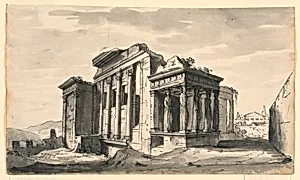
Stage Design, The Erectheion on the Acropolis, Athens, Greece
early 19th century
Classification
theater
Department
Smithsonian Collection
Museum
Smithsonian American Art Museum
Credit
Museum purchase through gift of various donors and from Eleanor G. Hewitt Fund
Accession Number
1938-88-305
Rights
Public Domain
About this artwork
Research in Progress
Art Historical Context
Romolo Achille Liverani an Italian artist active in the early 19th century (1809–1872), this captivating stage design depicting the Erectheion, the iconic ancient temple on Athens' Acropolis. Known its elegant Ionic columns and the famous Caryatid porch—where statues of draped maidens serve as supports—this neoclassical ruin symbolized the pinnacle of Greek architectural harmony. Liverani's work reflects the era's Romantic fascination with classical antiquity, a time when Europe's intellectuals and artists idealized ancient Greece as the cradle of Western civilization. As a theatrical backdrop or model, this piece would have transformed stages into immersive historical spectacles, likely for opera or drama productions in Italy's vibrant theater scene. Early 19th-century stage design emphasized perspective, lighting, and trompe-l'œil effects to evoke grandeur, drawing audiences into mythic worlds. Though the medium remains unidentified amid ongoing research, its classification as theater art highlights how such designs bridged fine art and performance, making antiquity accessible and alive. Housed in the Smithsonian American Art Museum, this design invites us to ponder the Erectheion's enduring allure—from its ancient role honoring Athena and Poseidon to its influence on Renaissance and modern architecture. A window into 19th-century cultural revival, it reminds visitors of art's power to resurrect history on the world's grandest stages.