
Moon flask
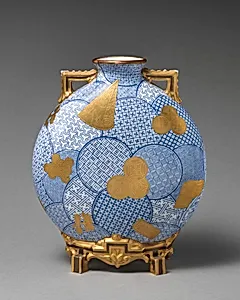
Medium
Bone china
Dimensions
confirmed: 8 3/16 × 6 7/8 × 3 1/4 in., 17.635oz. (20.8 × 17.5 × 8.3 cm, 500g)
Classification
Ceramics-Porcelain
Culture
British, Worcester
Department
European Sculpture and Decorative Arts
Museum
Metropolitan Museum of Art, New York, NY
Credit
Gift of Helene Fortunoff and Robert Grossman, 2017
Accession Number
2018.62.72
Rights
Public Domain
Art Historical Context
This elegant moon flask, produced by the renowned Worcester factory in 1878, exemplifies the refined artistry of British porcelain during the Victorian era. Crafted from bone china—a durable yet translucent material invented in England in the 18th century—the piece showcases the factory’s mastery of delicate forms and luminous glazes. Its distinctive flattened, circular shape draws inspiration from Persian and Islamic metalwork, reflecting the period’s fascination with exotic cultures and global trade influences. As a product of Worcester, one of Britain’s leading porcelain manufacturers since 1751, this flask highlights the 19th-century revival of decorative ceramics for display rather than everyday use. Its compact scale and graceful proportions suggest it was intended as a luxurious ornamental object, possibly for a mantel or cabinet. Now part of the Metropolitan Museum’s collection through a generous 2017 gift, the work invites visitors to appreciate the technical precision and cultural curiosity that defined British decorative arts in the late 1800s.
About the Artist
Worcester factory · 1751–2008
The Worcester porcelain factory, established in 1751 in Worcester, England, by physician Dr. John Wall and apothecary William Davis along with 14 partners, marked the birth of one of Britain's most enduring ceramic enterprises. Investing £4,500 at Warmstry House on the River Severn, the founders drew on contacts with the Bristol porcelain manufactory to develop a novel soft-paste porcelain using s...