
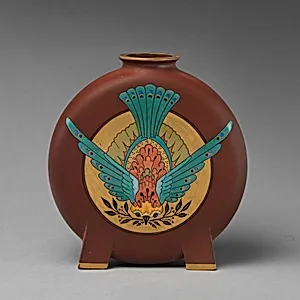
Moon flask with Aesthetic bird motif
1867
Medium
Red stoneware, enamel
Dimensions
confirmed: 6 × 5 3/16 × 2 1/8 in. (15.2 × 13.2 × 5.4 cm)
Classification
Ceramics-Porcelain
Culture
British, Stoke-on-Trent, Staffordshire
Department
European Sculpture and Decorative Arts
Museum
Metropolitan Museum of Art, New York, NY
Credit
Gift of Helene Fortunoff and Robert Grossman, 2017
Accession Number
2018.62.11
Rights
Public Domain
Art Historical Context
This exquisite *Moon Flask with Aesthetic Bird Motif*, crafted by the renowned British ceramics firm Minton(s) in 1867, exemplifies the Victorian era's fascination with exotic forms and artistic beauty. Housed in the Metropolitan Museum of Art's Department of European Sculpture and Decor Arts, this piece measures a compact 6 × 5 3/16 × 2 1/8 inches and is made from durable red stoneware adorned with vibrant enamel. The moon flask shape draws inspiration from ancient Chinese ceramics, a popular motif in 19th-century Europe as trade and collecting brought Eastern wares to Western markets. Minton(s), based in Stoke-on-Trent, Staffordshire—the epicenter of Britain's pottery industry—pioneered innovative techniques like this red stoneware body, which offered a rich, earthy tone ideal for bold enameling. The Aesthetic bird motif reflects the emerging Aesthetic Movement of the 1860s, which championed "art for art's sake" with its emphasis on graceful, nature-inspired designs influenced by Japanese art. Birds, symbols of freedom and elegance, were recurring themes, showcasing the firm's mastery in blending functionality with ornamental splendor. A gift to the Met from Helene Fortunoff and Robert Grossman in 2017, this flask highlights Minton's role in elevating ceramics from utilitarian objects to collector's treasures, bridging industrial production with high art during the height of the British Empire's global cultural exchanges.
About the Artist
Minton(s) · 1793–2001
Minton is among the most distinguished names in the history of British ceramics, a firm whose two and a quarter centuries of production encompass everything from blue transfer-printed earthenwares to the most rarefied decorative porcelain of the Victorian age. The company was founded in 1793 by Thomas Minton (1765–1836) in Stoke-upon-Trent, Staffordshire — the heart of England's pottery industry. ...