
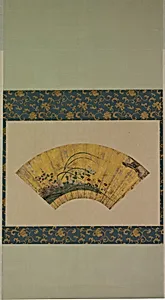
Moon over an Autumn Moor
16th century
Medium
Originally a fan mounted as a hanging scroll; ink, color, and silver on gilded paper
Dimensions
9 3/4 x 19 1/2 in. (24.8 x 49.5 cm)
Classification
Paintings
Culture & Period
Japan · Muromachi period (1392–1573)
Department
Asian Art
Museum
Metropolitan Museum of Art, New York, NY
Credit
Purchase, Friends of Asian Art Gifts, 1997
Accession Number
1997.140
Rights
Public Domain
Tags
Art Historical Context
In the 16th century, during Japan’s Muromachi, Kano Yukinobu “Moon over an Autumn Moor as a folding fan before it was later mounted as a hanging scroll. The compact work, just under ten inches high, depicts a quiet autumn landscape bathed in moonlight, with delicate flowers suggesting the season’s fleeting beauty. As a member of the prominent Kano school, Yukinobu blended precise brushwork with decorative elegance, reflecting the period’s refined tastes among the warrior and courtly classes. The painting’s original format as a fan is especially significant. Fans served both practical and ceremonial roles in Muromachi society, and their curved surfaces demanded compositions that remained balanced when opened or closed. Yukinobu employed ink, mineral colors, and silver accents on gilded paper to produce a luminous, shimmering effect that would have caught the light with every movement—qualities now preserved for quiet contemplation in scroll form. Today in the Metropolitan Museum of Art, the piece offers visitors an intimate encounter with Muromachi aesthetics, where seasonal imagery and technical refinement speak to a deep cultural reverence for nature’s cycles.