
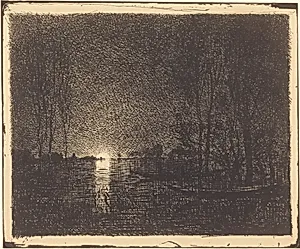
Moonlit Landscape
Medium
cliché-verre
Dimensions
plate: 16.6 x 20 cm (6 9/16 x 7 7/8 in.) sheet: 16.8 x 20.1 cm (6 5/8 x 7 15/16 in.)
Classification
Department
CG-E
Museum
National Gallery of Art, Washington, D.C.
Credit
Gift of Gaillard F. Ravenel and Frances P. Smyth-Ravenel
Accession Number
2000.7.12
Rights
Public Domain
Art Historical Context
**Moonlit Landscape** (1862) by Charles Daubigny captures the serene beauty of a nocturnal riverside scene, a hallmark of this French artist's lifelong fascination with nature. Daubigny, a leading figure in the Barbizon—a precursor to Impressionism— painted en plein air along the Oise River near Paris, emphasizing light, atmosphere, and unidealized landscapes. This intimate print evokes the quiet magic of moonlight on water and foliage, reflecting his poetic sensitivity to the changing moods of the natural world. The work's medium, *cliché-verre*, is particularly noteworthy. This experimental 19th-century technique involved drawing directly on a glass plate with ink or paint, then printing it via contact with light-sensitive paper—blending painting's expressiveness with photography's precision. Popular among Barbizon artists in the 1850s–60s, it allowed for painterly effects like soft edges and rich tones unattainable in traditional etching. Daubigny's few *cliché-verre* works from this period highlight his innovative spirit amid the era's photographic revolution. Housed in the National Gallery of Art as a gift from Gaillard F. Ravenel and Frances P. Smyth-Ravenel, this 16.6 x 20 cm plate exemplifies how printmaking democratized art, making Daubigny's luminous visions accessible to wider audiences. A gem for lovers of Romantic landscapes! (198 words)
About the Artist
Charles-François Daubigny · 1817–1878
Charles-François Daubigny was born on February 15, 1817, in Paris into a family of artists, with his father, Edmé-François Daubigny, a classical landscape painter, and his uncle, Pierre Daubigny, a miniaturist, providing his initial artistic training. He further studied under Jean-Victor Bertin, Jacques Raymond Brascassat, and Paul Delaroche at the École des Beaux-Arts, though he quickly moved bey...