
俵屋宗理筆 朝顔図屏風|Morning Glories
18th century
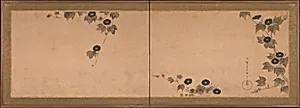
Medium
Two-panel folding screen; ink and color on paper
Dimensions
19 15/16 × 65 3/16 in. (50.6 × 165.6 cm)
Classification
Paintings
Culture & Period
Japan · Edo period (1615–1868)
Department
Asian Art
Museum
Metropolitan Museum of Art, New York, NY
Credit
The Howard Mansfield Collection, Purchase, Rogers Fund, 1936
Accession Number
36.100.27
Rights
Public Domain
Tags
Art Historical Context
Behold the delicate charm of *Morning Glories* (*Asagao-zu Byōbu*), a masterful two-panel folding screen byawaraya Sōri 18th-century Japan. Crafted during the Edo period (161–1868), this and color on paper artwork measures nearly six feet wide, designed as a *byōbu*—a traditional room divider that brought nature indoors for the elite. Sōri, a prominent figure in the Rinpa school, captures blooming morning glories (*asagao*) with their vibrant blues, purples, and twisting vines, evoking the fleeting beauty of summer. In Edo Japan, such screens were prized for their decorative splendor and symbolic depth. Morning glories, native to the region and celebrated in poetry, represent transience and renewal, mirroring Zen ideals of impermanence. Sōri's technique blends bold Rinpa motifs—characterized by asymmetrical composition, mineral pigments, and gold flecks (implied in the luminous style)—with meticulous ink washes for leaves and tendrils, showcasing the era's fusion of artistry and craftsmanship. Acquired through The Howard Mansfield Collection and now in the Metropolitan Museum of Art's Asian Art department, this piece invites visitors to ponder Japan's enduring love for floral ephemera, where everyday blooms become portals to philosophical wonder. (198 words)
About the Artist
Tawaraya Sōri · 1764–1780
**Tawaraya Sōri (c. 1764–1780)** was a Japanese painter active in the late Edo period who worked in the decorative Rinpa style associated with the Tawaraya school. Little is recorded about his early life or training, but he continued the elegant, ornamental traditions of Rinpa painting that emphasized bold patterns, gold backgrounds, and natural motifs drawn from classical Japanese aesthetics. Hi...