
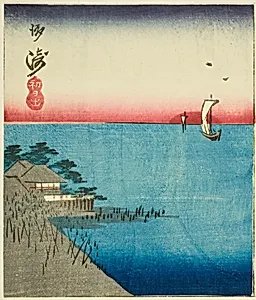
Morning Market at Nihon Bridge (Nihonbashi, asaichi), section of a sheet from the series "Cutouts of Famous Places in Edo (Harimaze Koto meisho)"
Medium
Color woodblock print; section of harimaze sheet (uncut sheet: 1939.1288)
Dimensions
15 × 12.8 cm (5 15/16 × 5 1/16 in.)
Classification
woodblock print
Department
Arts of Asia
Museum
Art Institute of Chicago
Accession Number
60505
Rights
Public Domain
Art Historical Context
Step into the vibrant streets of 19th-century Edo (modern-day Tokyo) with Utagawa Hiroshige *Morning Market at Nihon Bridge (ihonbashi, asaichi)*, a lively 1852 color woodblock print from the *Cutouts of Famous Places in Edo (imaze Koto meisho)*. This intimate scene captures the bustling dawn market at Nihonbashi, the "Japan Bridge" that served as the heart of the city's commerce and transportation network. Hiroshige, a master of the ukiyo-e ("pictures of the floating world") tradition, fills the compact 15 × 12.8 cm panel with vendors hawking fresh fish and produce, their colorful kimonos and wooden stalls evoking the everyday pulse of urban life. As a section of a *harimaze* sheet—designed to be cut into collectible souvenir panels—this print exemplifies innovative Edo-period printing. Woodblock techniques allowed for bold colors and fine details, achieved through multiple carved blocks inked in hues like Prussian blue and vermilion. Produced amid Japan's final years under the Tokugawa shogunate, these affordable images democratized art, letting commoners own glimpses of famous sights. Hiroshige's keen eye for atmospheric light and human activity influenced global artists like Van Gogh. Today, housed in the Art Institute of Chicago's Arts of Asia collection (1939.1288), it reminds us how a tiny print can transport us to a morning alive with commerce and community.
About the Artist
Utagawa Hiroshige · 1826–1869
Utagawa Hiroshige (1797–1858), born Andō Tokutarō, was the last great master of Japanese ukiyo-e woodblock printmaking and one of the most influential landscape artists in history. Born in Edo (modern Tokyo) into a low-ranking samurai family serving as fire wardens, Hiroshige transformed landscape printmaking into a poetic meditation on nature, weather, and everyday life. His revolutionary approac...