
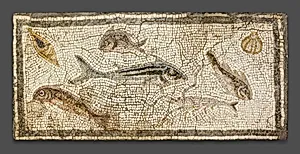
Mosaic Floor Panel Depicting Marine Life
200-230
Medium
Stone and mortar
Dimensions
39.4 × 85.7 × 6.4 cm (15 1/2 × 33 3/4 × 2 1/2 in.)
Classification
mosaic
Department
Arts of Greece, Rome, and Byzantium
Museum
Art Institute of Chicago
Accession Number
23276
Rights
Public Domain
About this artwork
Fish was a luxury food among the Romans. Mosaics depicting marine life were especially popular in and around Antioch (near modern Antakya, Turkey), an ancient city located on the Orontes River that was known for the beauty of its waters. This mosaic, which was discovered in a house in Daphne (modern Harbiye), a prosperous garden town near Antioch, depicts several species of fish and shellfish. The representation of these sea creatures was likely intended to convey a message about the owner’s wea...
Art Historical Context
This rectangular mosaic floor panel presents a lively underwater scene composed of small, irregular stones set into mortar. Several fish of varying sizes and colors swim across a pale background, including a central striped specimen, others rendered in earthy browns and grays, and a scallop shell positioned in the upper right. The surface shows the natural cracks and subtle tonal shifts typical of ancient stone tesserae, creating a sense of gentle movement within the contained frame. Dating to 200–230 CE and attributed to Ancient Roman makers, the work belongs to a long tradition of marine mosaics that decorated villas and public spaces across the Roman world. These compositions brought images of the sea into domestic settings, celebrating the abundance of nature through durable, colorful materials. Now in the collection of the Art Institute of Chicago, the panel offers visitors a direct glimpse of how Romans integrated art and daily life.
About the Artist
Ancient Roman
The artists attributed to "Ancient Roman" in museum collections represent the anonymous craftsmen who produced the vast output of sculpture, frescoes, mosaics, and reliefs defining Roman visual culture from the Republic (c. 509–27 BCE) to the late Empire (c. 395 CE). Individual identities remain elusive, as Roman makers were typically viewed as skilled tradesmen—often enslaved Greeks or provincial...