
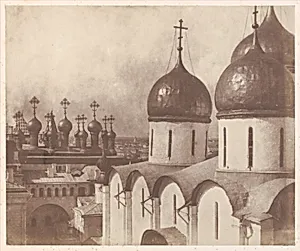
Moscow, Domes of Churches in the Kremlin
1852
Medium
Salted paper print from paper negative
Dimensions
Image: 17.9 x 21.6 cm (7 1/16 x 8 1/2 in.) Mount: 43.7 x 60.1 cm (17 3/16 x 23 11/16 in.)
Classification
Photographs
Department
Photographs
Museum
Metropolitan Museum of Art, New York, NY
Credit
Gilman Collection, Gift of The Howard Gilman Foundation, 2005
Accession Number
2005.100.66
Rights
Public Domain
Tags
Art Historical Context
Step into the mystical heart of 19th-century Moscow with Roger Fenton's *Moscow, Domes of in the Kremlin* (1852), a pioneering salted paper print from a negative. This intimate 17.9 x 21.6 cm image captures the onion-shaped domes of the Kremlin's ancient churches piercing the skyline, their golden crosses glinting against a hazy sky. Fenton, a trailblazing British photographer often as the founder of British photography, ventured to Russia that year, producing some of the earliest surviving photographs of the city. Taken just before Fenton's fame from Crimean War images, this work showcases the calotype process—William Henry Fox Talbot's innovative paper negative technique—which allowed for subtle tones and textures but yielded only a handful of prints per negative. The soft, atmospheric quality evokes the ethereal beauty of Orthodox architecture, symbolizing Russia's imperial grandeur amid growing Western curiosity about East. Housed in The Metropolitan Museum of Art's Gilman Collection, this print not only documents a timeless landmark but also marks a milestone in photography's evolution from studio novelty to on-location artistry, inviting us to ponder Moscow's enduring spiritual skyline through Fenton's discerning lens.
About the Artist
Roger Fenton · 1819–1819
Roger Fenton (1819–1869), born into a prosperous Lancashire merchant family as the son of banker and MP John Fenton, initially pursued a scholarly path, earning a first-class BA from the University of London in 1840 before studying law at University College London. He abandoned these pursuits for art, training as a painter under the history painter Charles Lucy in London by 1847—the two became clo...