
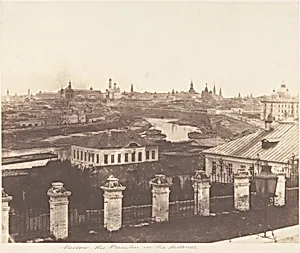
Moscow, the Kremlin in the Distance
1852
Medium
Salted paper print from paper negative
Dimensions
Image: 17.7 x 21.8 cm (6 15/16 x 8 9/16 in.) Mount (2nd): 43.8 x 59.1 cm (17 1/4 x 23 1/4 in.)
Classification
Photographs
Department
Photographs
Museum
Metropolitan Museum of Art, New York, NY
Credit
Gilman Collection, Museum Purchase, 2005
Accession Number
2005.100.668
Rights
Public Domain
Tags
Art Historical Context
In 1852, British photographer Roger Fenton captured *Moscow, the Kremlin in Distance*, one of his earliest and most evocative works. This salted paper print from a paper—part of the pioneering calotype—showcases Fenton's skill in harnessing photography's nascent potential to document grand architecture. The medium, popular in the1840s and 1850s, produced soft, warm-toned images with rich detail, allowing Fenton to convey the hazy allure of a distant skyline against the Russian horizon. Fenton's journey to Russia that year was a bold endeavor, predating his fame from Crimean War photographs. Commissioned by the British government, he traversed Moscow, immortalizing its imperial landmarks like the Kremlin—a fortified citadel symbolizing centuries of Russian power since the 15th century. Viewed from afar (image measures 17.7 x 21.8 cm), the composition emphasizes scale and mystery, inviting viewers to ponder the city's vastness amid the early photographic era's technical challenges, such as long exposures under natural light. Today, housed in The Metropolitan Museum of Art's Gilman Collection, this print highlights photography's role in bridging East and West, offering a window into mid-19th-century Moscow before rapid modernization. Fenton's precise yet atmospheric style laid groundwork for travel photography, blending documentation with subtle artistry.
About the Artist
Roger Fenton · 1819–1819
Roger Fenton (1819–1869), born into a prosperous Lancashire merchant family as the son of banker and MP John Fenton, initially pursued a scholarly path, earning a first-class BA from the University of London in 1840 before studying law at University College London. He abandoned these pursuits for art, training as a painter under the history painter Charles Lucy in London by 1847—the two became clo...