
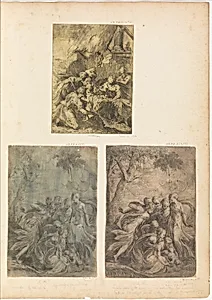
Moses Rescued from the Nile
ca. 1540–44
Medium
Etching
Classification
Prints
Department
Drawings and Prints
Museum
Metropolitan Museum of Art, New York, NY
Credit
Harris Brisbane Dick Fund, 1927
Accession Number
27.78.2(298)
Rights
Public Domain
Tags
Art Historical Context
This etching by Andrea Schiav, created around 154–44, captures dramatic biblical moment when the Moses is rescued from Nile by Pharaoh’s daughter her attendants. The brings together figures of men and women in lively scene that emphasizes both vulnerability of the child and the compassion of those who save him As a print, the reflects the growing importance of etching in the sixteenth, a technique that allowed to create fluid lines and expressive while making images more widely available beyond a single painting. Schiavone, also known as Andrea Meldola, worked in Venice during a period when printmaking flourished alongside painting and drawing. Etchings like this one often served as both independent artworks and studies for larger compositions, helping to spread religious narratives across Europe. The delicate lines and tonal contrasts typical of the medium highlight the emotional intensity of the rescue story without relying on color. Housed in the Metropolitan Museum of Art’s Department of and Prints, this piece invites viewers to consider how biblical tales were reimagined for new audiences through the accessible art of printmaking.
About the Artist
Andrea Schiavone (Andrea Meldola) · 1510–1563
Andrea Schiavone, born Andrea Meldolla around 1510 or 1515 in Zara (modern Zadar, Croatia), in Venetian-ruled Dalmatia, hailed from a family rooted in Meldola near Forlì in Romagna, Emilia-Romagna. His father, Simon Meldolla, served as a garrison commander there, and both parents originated from Meldola, where the family held property into the early 16th century. Nicknamed "Schiavone"—"the Slav"—a...