
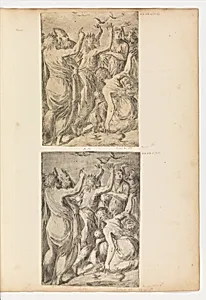
Moses Showing the Quails to the Israelites
Medium
Etching
Classification
Prints
Department
Drawings and Prints
Museum
Metropolitan Museum of Art, New York, NY
Credit
Harris Brisbane Dick Fund, 1927
Accession Number
27.78.2(316)
Rights
Public Domain
Tags
Art Historical Context
In the biblical Book of Exodus, God provides manna and quails to sustain the Israelites during their wilderness wanderings, a miracle depicted with dramatic flair in Andrea Schiavone's *Moses Showing the Quails to the Israelites* (ca. 1545). This etching captures Moses presenting the divinely sent birds to his people, blending spiritual narrative with vivid naturalism. Schiav, a Venetian Renaissance artist (also known as Andrea Meld), drew inspiration from masters like Titian, infusing his work with Mannerist energy—elongated figures, swirling motion, and a sense of divine abundance amid the crowd of men and fluttering birds. As one of the earliest Italian masters of etching, Schiavone revolutionized printmaking in mid-16th-century Venice. Unlike engraving's rigid lines, etching allowed fluid, painterly strokes via acid-bitten plates, enabling expressive textures for feathers, robes, and dynamic poses. This technique made his prints highly collectible, bridging painting and reproduction for wider audiences. Housed in the Metropolitan Museum of Art's Drawings and Prints department (Harris Brisbane Dick Fund, 1927), this work exemplifies Renaissance innovation in biblical storytelling, inviting viewers to ponder faith, provision, and artistic ingenuity.
About the Artist
Andrea Schiavone (Andrea Meldola) · 1510–1563
Andrea Schiavone, born Andrea Meldolla around 1510 or 1515 in Zara (modern Zadar, Croatia), in Venetian-ruled Dalmatia, hailed from a family rooted in Meldola near Forlì in Romagna, Emilia-Romagna. His father, Simon Meldolla, served as a garrison commander there, and both parents originated from Meldola, where the family held property into the early 16th century. Nicknamed "Schiavone"—"the Slav"—a...