
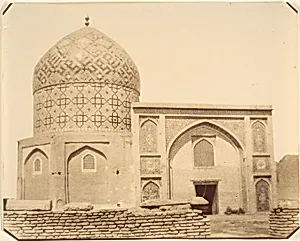
[Mosque of Nasser-eddin Shah, Teheran, Iran]
1840s–60s
Classification
Photographs
Department
Photographs
Museum
Metropolitan Museum of Art, New York, NY
Credit
Gift of Charles K. and Irma B. Wilkinson, 1977
Accession Number
1977.683.16
Rights
Public Domain
Tags
Art Historical Context
Step into the opulent world of 19th-century Iran through Luigi Pesce's captivating photograph of the Mosque of Nasser-eddin Shah Teheran. Taken between the 1840s and 1860s, this image captures the grandeur of Qajar-era architecture during the reign of Naser al-Din Shah (r. 1848–1896), whose name graces the mosque. Pesce an Italian photographer pioneering early photography in the Middle East documented this iconic structure with a keen eye for intricate tilework, domes, and minarets that define Persian Islamic design. As one of the earliest photographs of Iranian mosques, this work holds immense historical value. Pesce employed the calotype process—using paper negatives—to produce richly textured images that preserved architectural details otherwise vulnerable to time and change. Held in the Metropolitan Museum of Art's Department of Photographs (gift of Charles K. and Irma B. Wilkinson, 1977), it offers a rare window into Teheran's urban landscape amid growing European interest in Orientalism. This photograph not only showcases the mosque's cultural role as a center of worship and community but also highlights photography's power to bridge East and West. Visitors today can appreciate how Pesce's lens immortalized a symbol of Shia Islamic heritage, blending artistry with documentary precision.
About the Artist
Luigi Pesce · 1818–1891
**Luigi Pesce (1828–1864)** was an Italian colonel and pioneering amateur photographer from Naples in the Kingdom of the Two Sicilies, whose work captured some of the earliest images of Iran's ancient monuments and 19th-century life. Arriving in Persia in 1848 during the reign of Naser al-Din Shah Qajar, Pesce was tasked with training Iranian infantry units, a mission that positioned him ideally t...