
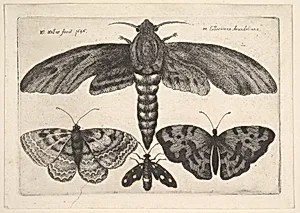
Moth and three butterflies
Medium
Etching; first state of three
Dimensions
Plate: 3 1/8 × 4 9/16 in. (8 × 11.6 cm) Sheet: 3 9/16 × 5 1/8 in. (9.1 × 13 cm)
Classification
Prints
Department
Drawings and Prints
Museum
Metropolitan Museum of Art, New York, NY
Credit
Harris Brisbane Dick Fund, 1926
Accession Number
26.72.116
Rights
Public Domain
Tags
Art Historical Context
Created in 1646 by the celebrated Bohemian etcher Wenceslaus Hollar, *Moth and three butterflies* exemplifies the artist’s remarkable ability to capture the delicate beauty of the natural world in miniature. Hollar, who spent much of his career in England, was renowned for his precise and sensitive printmaking during a turbulent period marked by the English Civil War. This small etching reflects the seventeenth-century fascination with entomology when artists and naturalists alike turned their attention to studying insects as wonders of divine creation. Executed in the etching technique, the work reveals Hollar’s mastery of fine, controlled lines that convey the translucent wings and subtle patterns of the insects. As the first state of three, it represents the artist’s initial vision before any later revisions. Measuring just over three by four inches, the print demonstrates how Hollar transformed a modest sheet of paper into an intimate study that invites close observation. Today housed in the Metropolitan Museum of Art’s Department of Drawings and Prints, this delicate impression continues to charm viewers with its quiet celebration of nature’s intricate details.
About the Artist
Wenceslaus Hollar · 1607–1677
Wenceslaus Hollar (1607-1677) was a prolific Bohemian etcher who became one of the most accomplished printmakers of the seventeenth century. Born in Prague, he trained under Matthäus Merian in Frankfurt before entering the service of Thomas Howard, Earl of Arundel, in 1636. Hollar spent most of his career in England, where he produced approximately 2,740 etchings documenting an extraordinary range...