
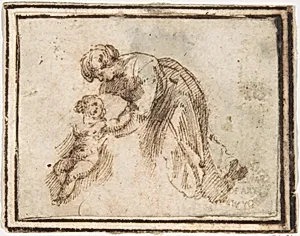
Mother and Child
1624–63
Medium
Pen and brown ink. Framing lines in pen and brown ink on mount
Dimensions
1-9/16 x 2-1/16 in. (4.0 x 5.3 cm)
Classification
Drawings
Department
Drawings and Prints
Museum
Metropolitan Museum of Art, New York, NY
Credit
Gift of Cornelius Vanderbilt, 1880
Accession Number
80.3.529
Rights
Public Domain
Tags
Art Historical Context
In the intimate world of 17th-century Italian drawings, Francesco Allegrini's *Mother and Child* (ca. 1624–63) captures a tender, universal moment of maternal affection. Rendered in pen and brown ink on diminutive sheet—just 1-9/16 x 2-1/16 inches (4.0 x 5.3 cm)—this work exemplifies the artist's skill in creating emotional depth through precise, fluid lines. The subtle framing lines in the same medium, added to its mount, highlight its status as a finished, collectible piece rather than a mere sketch, inviting close contemplation. Allegrini, a Roman artist active during the Baroque era, drew from the era's emphasis on naturalism and human emotion, influenced by the Carracci school's legacy. Themes of mothers and infants were timeless in Italian art, echoing religious iconography like the Madonna and Child while grounding it in everyday life. This drawing's modest scale underscores the Baroque fascination with *disegno*—the nobility of draftsmanship—as an art form in itself, prized by collectors for its immediacy and virtuosity. A generous gift to the Metropolitan Museum of Art from Cornelius Vanderbilt in 1880, *Mother and Child* now resides in the Drawings and Prints department, offering visitors a window into the quiet poetry of 17th-century Italian mastery. Pause here to appreciate how Allegrini's economical strokes evoke profound warmth in such a tiny space.
About the Artist
Francesco Allegrini · 1615–1679
Francesco Allegrini (c. 1615/20–after 1679), born likely in Rome to the painter Flaminio Allegrini from Cantiano near Gubbio, emerged from a family of artists that included his sister, Anna Angelica Allegrini. He trained under Giuseppe Cesari, known as the Cavalier d’Arpino, around 1638–40, before entering the studio of Pietro da Cortona, whose dynamic Baroque style profoundly shaped his own. Elec...