
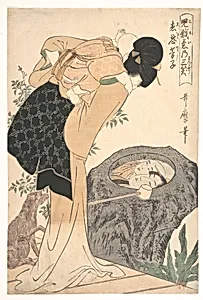
児戯意乃三笑 恵恩芳子|Mother and Child
ca. 1800
Medium
Woodblock print; ink and color on paper
Dimensions
H. 14 5/16 in. (36.4 cm); W. 9 9/16 in. (24.3 cm)
Classification
Prints
Culture & Period
Japan · Edo period (1615–1868)
Department
Asian Art
Museum
Metropolitan Museum of Art, New York, NY
Credit
Henry L. Phillips Collection, Bequest of Henry L. Phillips, 1939
Accession Number
JP2811
Rights
Public Domain
Tags
Art Historical Context
In the vibrant world of Edo-period Japan (1615–1868), Kitagawa Utam's *Mother and Child* (ca. 1800), known in Japanese as *Kodakara Ino Sanwarai Eion Yōko*, captures a tender moment of domestic joy. This woodblock print, in ink and color on paper, showcases Utamaro's mastery ukiyo-e—the "pictures of the floating world" that celebrated everyday beauty amid urban pleasures. Measuring about 14 by 9 inches, it depicts a mother and playful child, likely sharing laughter with accompanying dogs, evoking warmth and innocence in a bustling era. Utamaro, one of the era's greatest bijin-ga artists (specializing in portraits of beautiful women), elevated ordinary scenes like motherhood to poetic heights. His innovative techniques—subtle gradations of color (via intricate woodblock carving and multiple impressions) and flowing lines—breathe life into his subjects, making them seem almost tangible. Prints like this were affordable art for the masses, democratizing high culture during Japan's peaceful Edo period. From the Metropolitan Museum of Art's Henry L. Phillips Collection, this piece highlights the cultural reverence for family bonds and child-rearing, offering a glimpse into 19th-century Japanese life. Pause to admire how Utamaro turns simplicity into timeless elegance!
About the Artist
Kitagawa Utamaro · 1753–1806
Kitagawa Utamaro (c. 1753-1806) was one of the most celebrated masters of ukiyo-e woodblock printing, revolutionizing the art of bijin-ga (pictures of beautiful women) during Japan's Edo period. Born Kitagawa Ichitaro, his early life remains shrouded in mystery, with conflicting accounts placing his birth in Kyoto, Osaka, Yoshiwara in Edo (modern Tokyo), or Kawagoe in Musashi Province. Under the t...