
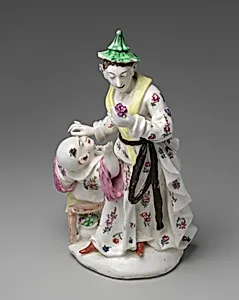
Mother and child group
1750–55
Medium
Soft-paste porcelain
Dimensions
Height: 8 13/16 in. (22.4 cm)
Classification
Ceramics-Porcelain
Culture
British, Derby
Department
European Sculpture and Decorative Arts
Museum
Metropolitan Museum of Art, New York, NY
Credit
Gift of R. Thornton Wilson, in memory of Florence Ellsworth Wilson, 1951
Accession Number
51.1.3
Rights
Public Domain
Tags
Art Historical Context
This delightful "Mother and Child Group," crafted by the Derby Porcelainufactory between 1750 and 1755, exemplifies the golden age of British porcelain production. Standing at just over 8 inches tall, this soft-paste porcelainine captures a tender domestic scene infused with Chinoiserie flair—Europe's whimsical interpretation of Chinese aesthetics. Derby, one of England's pioneering porcelain factories founded in 1750, specialized in these finely modeled groups, using soft-paste porcelain, a softer, more translucent clay body that allowed artisans to achieve intricate details and vibrant enamel colors before the mastery of true hard-paste porcelain. The Chinoiserie style, wildly popular in 18th-century Britain, blended exotic Oriental motifs like flowing robes and pagoda-inspired poses with relatable European subjects, such as motherly affection. This piece reflects the era's cultural fascination with the East, spurred by expanding trade, while showcasing Derby's technical prowess in hand-molding, slip-casting, and overglaze painting. Such figurines adorned middle-class mantelpieces, bridging fine art and everyday luxury. A gift to The Metropolitan Museum of Art in 1951, this work highlights Derby's role in democratizing porcelain artistry, making "exotic" elegance accessible beyond royal courts. Visitors, imagine this glowing softly by candlelight, evoking universal bonds across cultures.
About the Artist
Derby Porcelain Manufactory · 1751–1785
The Derby Porcelain Manufactory stands as one of the foundational institutions of British ceramic art, producing some of the finest figures and tablewares made in England during the eighteenth and early nineteenth centuries. Its origins can be traced to the work of André Planché, a Huguenot immigrant from Saxony who settled in Derby around 1745 and began producing soft-paste porcelain figures and ...