
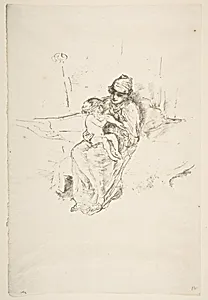
Mother and Child, No. 1
1891 and 1895
Medium
Transfer lithograph with scraping and stumping; second state of two (Chicago); printed in black ink on fine white laid paper
Dimensions
11 7/8 x 7 3/4 in. (30.2 x 19.7 cm)
Classification
Prints
Department
Drawings and Prints
Museum
Metropolitan Museum of Art, New York, NY
Credit
Harris Brisbane Dick Fund, 1917
Accession Number
17.3.222
Rights
Public Domain
Tags
Art Historical Context
In the intimate *Mother and Child, No 1* (1891 and 1895), James McNeill Wh captures a tender moment of maternal affection, a theme that contrasts with his more atmospheric nocturnes and portraits. Created during the artist's later career in London, this transfer lithograph reflects Whistler's mastery of printmaking as a democratic medium, allowing subtle tonal effects akin to his oil paintings. Printed in black ink on fine white laid paper it measures a modest 11 7/8 x 7 3/4 inches, inviting close contemplation. Whistler employed innovative techniques here: drawing on transfer paper for indirect application to the lithographic stone, then refining with scraping for crisp highlights and stumping—a dry blending method—to achieve velvety shadows and soft modeling. This second state from the Chicago edition showcases his pursuit of harmony and "art for art's sake," prioritizing mood over narrative. Acquired through the Harris Brisbane Dick Fund in 1917, it now graces the Metropolitan Museum of Art's Prints collection. Evoking universal bonds, the work underscores Whistler's influence on modern printmaking, bridging 19th-century realism with impressionistic subtlety. A quiet gem amid his bolder oeuvre, it reminds us of everyday beauty's quiet power.
About the Artist
James McNeill Whistler · 1834–1903
James Abbott McNeill Whistler (1834-1903) was an American-born painter and printmaker who became a leading figure in the Aesthetic Movement and pioneer of Tonalism and Japonisme. He revolutionized art by championing "art for art's sake" and treating paintings as visual equivalents of musical compositions, titling works as "arrangements," "harmonies," and "nocturnes" to emphasize formal qualities o...