
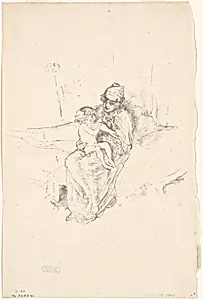
Mother and Child, No. 1
1891/1895 (printed 1904)
Medium
lithograph in black on laid paper
Dimensions
image (irregular): 18.42 × 19.37 cm (7 1/4 × 7 5/8 in.) sheet: 31.12 × 20.96 cm (12 1/4 × 8 1/4 in.)
Classification
Department
CG-W
Museum
National Gallery of Art, Washington, D.C.
Credit
Corcoran Collection (Bequest of Frank B. Bristow)
Accession Number
2015.19.1490
Rights
Public Domain
Art Historical Context
James McNeill Whistler’s *Mother and Child, No. 1* (1891/1895, printed 1904) captures an intimate domestic moment through the delicate medium of black lithograph on laid paper. Drawn during Whistler’s later career, when he was celebrated for his Aesthetic movement principles—prioritizing harmony, beauty, and “art for art’s sakethis print measures a modest 18.42 × 19.37 cm in its irregular image area, inviting close contemplation. The technique of lithography, which Whistler mastered, allowed him to achieve fluid, painterly effects akin to drawing directly on stone, blending subtle tones and lines with remarkable spontaneity. Whistler, an American expatriate in London, produced this work amid his exploration of printmaking as a democratic art form, making his refined visions accessible beyond oil paintings like his iconic *Arrangement in Grey and Black No.1* (Whistler’s Mother). The delayed printing in 1904 reflects his meticulous process, often editioning works years after initial creation. This tender subject evokes universal themes of maternal bond, rendered with Whistler’s signature subtlety and restraint. Now part of the National Gallery of Art’s Corcoran Collection (Bequest of Frank B. Bristow), *Mother and Child, No. 1* exemplifies Whistler’s enduring influence on modern printmaking, bridging 19th-century impressionism with 20th-century abstraction. Visitors will appreciate its quiet elegance on laid paper, a nod to traditional craftsmanship.
About the Artist
James McNeill Whistler · 1834–1903
James Abbott McNeill Whistler (1834-1903) was an American-born painter and printmaker who became a leading figure in the Aesthetic Movement and pioneer of Tonalism and Japonisme. He revolutionized art by championing "art for art's sake" and treating paintings as visual equivalents of musical compositions, titling works as "arrangements," "harmonies," and "nocturnes" to emphasize formal qualities o...