
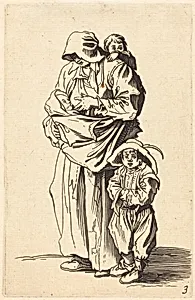
Mother and Three Children
1622 or later
Medium
etching on laid paper
Dimensions
sheet (trimmed to plate mark): 14.1 × 9.2 cm (5 9/16 × 3 5/8 in.)
Classification
Department
CG-E
Museum
National Gallery of Art, Washington, D.C.
Credit
Rosenwald Collection
Accession Number
1949.5.323
Rights
Public Domain
Art Historical Context
This poignant etching, *Mother and Three Children*, after the renowned Baroque artist Jacques Callot around 1622 or later, captures a tender yet somber family scene on a modest scale—measuring just 14. × 9.2 cm. Callot, a masterful French printmaker who worked extensively in Italy and Lorraine, was celebrated for his intricate depictions of everyday life,, and human suffering. Works like this likely draw from his famous *Beggar's Suite* (Les Gueux), a series portraying the marginalized "bohemians" and vagrants of 17th-century Europe, reflecting the social upheavals of the Thirty Years' War era. Etched on laid paper—a traditional support with visible chain lines that enhanced print clarity—Callot's technique showcased revolutionary precision. Using a fine etching needle on copper plates, he achieved extraordinary detail in tiny formats, allowing mass production of affordable, narrative-rich images. This "after Callot" version highlights his enduring influence, as copies proliferated due to the popularity of his empathetic, unflinching realism. Housed in the National Gallery of Art's Rosenwald Collection (Department CG-E), the print invites reflection on familial resilience amid hardship, blending artistic virtuosity with cultural commentary on 17th-century inequality. A small gem that speaks volumes.
About the Artist
after Jacques Callot
**Jacques Callot (c. 1592–1635)**, the master whose designs inspired the works attributed "after Jacques Callot," was a pioneering French Baroque printmaker and draftsman born in Nancy, capital of the independent Duchy of Lorraine (now northeastern France). From a noble family—his father served as master of ceremonies and herald-at-arms to the Duke of Lorraine—young Callot was apprenticed to a gol...