
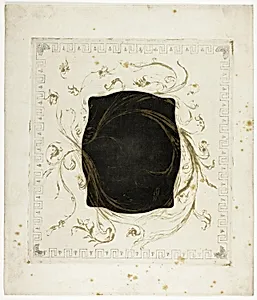
Mount for Anemonies
1897–99
Medium
Softground etching, aquatint, lavis and drypoint in black and yellow metallic on ivory Japanese paper
Dimensions
Image: 28.3 × 25.4 cm (11 3/16 × 10 in.); Plate: 29.8 × 26.5 cm (11 3/4 × 10 7/16 in.); Sheet: 38.3 × 32.9 cm (15 1/8 × 13 in.)
Classification
etching
Department
Prints and Drawings
Museum
Art Institute of Chicago
Accession Number
211070
Rights
Public Domain
Art Historical Context
Theodore Roussel’s *Mount for Anemonies* (1897–99) captures the refined elegance of late-Victorian printmaking at a moment when artists were reimagining etching as a vehicle for color and atmosphere. A British painter and printmaker closely associated with James McNeill Whistler, Roussel helped pioneer tonal and color processes that moved etching beyond its traditional black-and-white limits. Created at the height of the British etching revival, the work reflects both the period’s fascination with Japonisme—evident in the choice of ivory Japanese paper—and a broader interest in decorative floral subjects suited to intimate domestic settings. The print’s technical sophistication is remarkable. Roussel combined softground etching, aquatint, lavis, and drypoint, then added touches of yellow metallic ink to suggest the luminous quality of anemone petals or perhaps a gilded mount. These layered techniques allow delicate gradations of tone and a subtle shimmer that shifts with light, giving the impression of a hand-colored drawing rather than a conventional print. The modest size further encourages close viewing, rewarding the observer with fine textural nuances. Today in the Art Institute of Chicago’s collection, *Mount for Anemonies* stands as a quiet testament to Roussel’s experimental spirit and the fertile exchange between painting and printmaking at the turn of the twentieth century.
About the Artist
Theodore Roussel · 1847–1926
Theodore Casimir Roussel was born on 23 March 1847 in Lorient, Brittany, France, into a naval family. After serving in the Franco-Prussian War, he began painting in 1872 as an entirely self-taught artist, initially rendering scenes of daily life in the meticulous style of the Old Masters. In 1878, he settled permanently in London, where he immersed himself in the vibrant British art scene. There, ...