
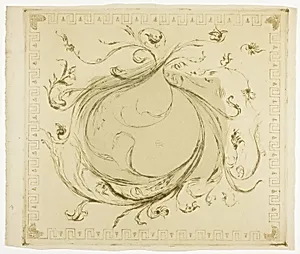
Mount for The Sea at Bognor
1897–99
Medium
Softground etching, aquatint, lavis and drypoint in yellow-brown metallic, off-white, and blue-gray on ivory laid paper
Dimensions
Image: 28.3 × 25.4 cm (11 3/16 × 10 in.); Plate: 29.8 × 26.5 cm (11 3/4 × 10 7/16 in.); Sheet: 32.8 × 27.9 cm (12 15/16 × 11 in.)
Classification
etching
Department
Prints and Drawings
Museum
Art Institute of Chicago
Accession Number
211069
Rights
Public Domain
Art Historical Context
Theodore Roussel’s “Mount for The Sea at Bognor” exemplifies the innovative spirit of late-nineteenth-century printmaking. Created between 1897 and 1899, the work reflects the period’s renewed interest in etching as a fine-art medium, when artists sought to elevate the technique beyond mere reproduction. Roussel, working in Britain, explored subtle color harmonies and textured surfaces that blurred the line between print and painting. The print’s complex technique—combining softground etching, aquatint, lavis, and drypoint—allows for delicate tonal gradations and a luminous, almost metallic sheen. Printed in yellow-brown, off-white, and blue-gray inks on ivory laid paper, it evokes the shifting light and atmosphere of the English coast. Such layered processes required remarkable precision, demonstrating Roussel’s mastery and his desire to capture fleeting natural effects within the demanding constraints of the etching plate. As a preparatory “mount,” the sheet offers a rare glimpse into the artist’s working method, revealing how he built mood and depth through successive tonal passages. Today it stands as a quiet testament to the poetic possibilities of printmaking at the turn of the twentieth century.
About the Artist
Theodore Roussel · 1847–1926
Theodore Casimir Roussel was born on 23 March 1847 in Lorient, Brittany, France, into a naval family. After serving in the Franco-Prussian War, he began painting in 1872 as an entirely self-taught artist, initially rendering scenes of daily life in the meticulous style of the Old Masters. In 1878, he settled permanently in London, where he immersed himself in the vibrant British art scene. There, ...