
Mountain Landscape
ca. 1761–63
Medium
Hanging scroll; ink and color on silk
Dimensions
Image: 18 x 25 in. (45.7 x 63.5 cm) Overall with mounting: 54 1/2 x 29 5/8 in. (138.4 x 75.2 cm) Overall with knobs: 54 1/2 x 32 in. (138.4 x 81.3 cm)
Classification
Paintings
Culture & Period
Japan · Edo period (1615–1868)
Department
Asian Art
Museum
Metropolitan Museum of Art, New York, NY
Credit
The Howard Mansfield Collection, Purchase, Rogers Fund, 1936
Accession Number
36.100.66
Rights
Public Domain
Tags
About this artwork
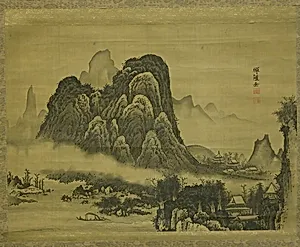
Soga Shōhaku created this distinctive mountain landscape around 1761-63, demonstrating the bold, eccentric style that set him apart from conventional eighteenth-century Japanese painting schools. Shōhaku, one of Edo period's most individualistic painters, rejected the polish of academic traditions in favor of exaggerated forms, dramatic contrasts, and intense expression. This hanging scroll, executed in ink and color on silk, depicts a Chinese-style landscape with steep mountains, architectural ...
Art Historical Context
Soga Shōhaku's *Mountain Landscape*, created around 1761–63 during Japan's Edo period (16151868), is a hanging scroll in ink and color on silk This traditional Japanese format, designed for selective display in homes or temples, captures a dramatic Chinese-inspired vista of steep mountains, rocky outcrops, and subtle architectural hints. Shōhaku, an eccentric Kyoto-based painter active in the mid-18th century, the refined polish of contemporary schools like Kano or Nanga, embracing instead a bold, individualistic style that contemporaries either hailed as brilliant or dismissed as crude. What sets this work apart is Shōhaku's restless, angular brushwork, which infuses classical Song dynasty compositions with surging energy. Jagged rocks twist with vitality, stark ink contrasts clash against vast empty spaces, and vivid colors heighten the asymmetry, evoking nature's raw power rather than serene harmony. In an era when artistic experimentation bloomed alongside tradition, Shōhaku's exaggerated forms exemplified radical personal expression. Acquired in 1936 as part of the Howard Mansfield Collection at The Metropolitan Museum of Art, this scroll highlights Japanese painting's capacity for innovation. It invites viewers to appreciate how one artist's defiant originality could challenge conventions while honoring historical roots, making it a gem of Edo-period individualism.
About the Artist
Soga Shōhaku · 1730–1781
Japanese, 1730–1781