
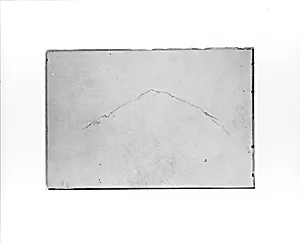
Mountain Sketch (from Sketchbook X)
Medium
Graphite on off-white wove paper
Dimensions
5 x 7 1/2 in. (12.7 x 19.1 cm)
Classification
Drawing
Culture
American
Department
The American Wing
Museum
Metropolitan Museum of Art, New York, NY
Credit
Purchase, Gifts in memory of Stephen D. Rubin, 1992
Accession Number
1992.2.2nn verso
Rights
Public Domain
Tags
Art Historical Context
William Trost Richards, a American artist of the late 19 century, captured the rugged beauty of mountains in this intimate *Mountain Sketch* from his *Sketchbook X*, dated1885. Rendered in graphite on off-white wove paper, the modest 5 x 7 1/2-inch sheet exemplifies Richards' meticulous approach to nature studies. As a key figure in American landscape art, influenced by the Hudson River School emphasis on realistic detail and the sublime in the natural world, he filled numerous sketchbooks with such on-site observations during his travels. Graphite's versatility allowed Richards to achieve subtle shading and precise lines, essential for conveying the texture of rocky peaks and atmospheric depth in a portable format. These sketches served as vital preparations for his larger oil and watercolor paintings, reflecting the era's Romantic fascination with untamed American wilderness amid rapid industrialization. Housed in The Metropolitan Museum of Art's American Wing, this piece—acquired through a 1992 purchase honoring Stephen D. Rubin—offers visitors a glimpse into the artist's process, bridging raw fieldwork and polished masterpieces. Today, it reminds us of 1880s America's cultural reverence for mountains as symbols of national identity and spiritual renewal, inviting quiet contemplation of nature's enduring allure.
About the Artist
William Trost Richards · 1833–1905
William Trost Richards (1833–1905) was a prominent American landscape and marine painter born in Philadelphia, where he attended Central High School before beginning his artistic training. Between 1850 and 1855, he studied part-time under the German-born Hudson River School artist Paul Weber while working as a designer and illustrator of ornamental metalwork. He exhibited his first works at the Pe...