
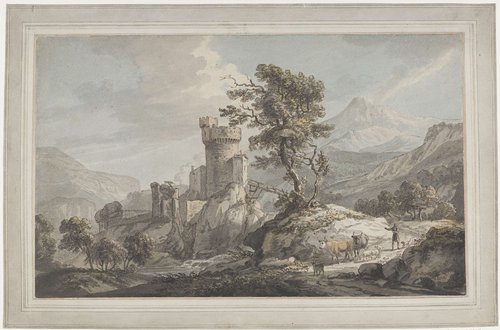
Mountainous Landscape with a Fortress
1760
Medium
pen
Dimensions
313; 513
Rights
Public Domain
About this artwork
signature and date: ‘P. Sandby 1760’
Art Historical Context
**Mountainous Landscape with a** *Paul Sand, 1760, pen, 313 × 513 mm* Paul Sandby, often hailed as the "father of English watercolour," crafted this intricate pen drawing in 176, bearing his clear signature and date. At around 29 years old,by was already a master topographical artist, renowned for precise depictions of British landscapes. This work captures a dramatic mountainous scene dominated by a sturdy fortress, evoking the rugged terrains he explored during his military surveying days in Wales and Scotland. Created in pen—likely ink on paper—this medium highlights Sandby's skill in achieving fine lines and textures without color, emphasizing contour, shadow, and architectural detail. In the 18th century, such drawings were vital for mapping and documentation, bridging art and science amid Britain's growing fascination with its own wild Romantic landscapes. Sandby's topographical precision influenced the watercolor tradition and the Royal Academy, where he later became a founding member. This piece invites visitors to appreciate how everyday exploration birthed enduring views of nature's grandeur and human fortitude.
About the Artist
Paul Sandby · 1731–1809
Paul Sandby (1731–1809), an English painter and draughtsman born in Nottingham, is celebrated as the father of English watercolour landscape painting. He learned drawing from his older brother Thomas Sandby, a prominent architect and artist, and followed him into the Military Drawing Office at the Tower of London, where they honed their skills as military draughtsmen. In 1747, Paul accompanied Tho...