
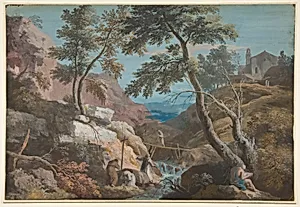
Mountainous Landscape with Hermits
1676–1730
Medium
Gouache on kidskin
Dimensions
11-3/4 x 17-5/16 in. (29.9 x 43.9 cm)
Classification
Drawings
Department
Drawings and Prints
Museum
Metropolitan Museum of Art, New York, NY
Credit
Bequest of Harry G. Sperling, 1971
Accession Number
1975.131.46
Rights
Public Domain
Tags
Art Historical Context
Marco Ricci's *Mountainous Landscape with Hermits* (ca. 1700–1730) captures the sublime beauty of jagged peaks and serene valleys in a compact gouache on kidskin, just 11-3/4 x 17-5/16 inches. This Venetian artist's intimate drawing depicts solitary male figures—likely hermitsamidst towering mountains, with a prominent cross symbolizing spiritual retreat and contemplation. Ricci, active during the late Baroque period, drew from the grand landscape traditions of his native Italy, blending real and imagined vistas in a style that foreshadowed the vedute of later masters like Canaletto. The choice of gouache, an opaque watercolor, on kidskin (goatskin parchment) is particularly noteworthy. This medium allowed Ricci to achieve luminous, jewel-like colors and precise detailing on a durable yet delicate support, ideal for portable sketches or collector's pieces. Such works were prized in 18th-century Europe for their poetic evocation of nature's majesty and humanity's humble place within it, reflecting Counter-Reformation ideals of piety amid wilderness. Today, this gem resides in the Metropolitan Museum of Art's Drawings and Prints department, a bequest from Harry G. Sperling in 1971. It invites visitors to ponder the harmony of rugged terrain and quiet devotion, showcasing Ricci's mastery in miniature.
About the Artist
Marco Ricci · 1676–1730
Marco Ricci (1676–1730) was born on June 6 in Belluno, in the Republic of Venice, into a family steeped in artistic tradition as the nephew of the renowned Baroque painter Sebastiano Ricci. He received his first instruction in art from his uncle, likely during a period in Milan from 1694 to 1696, before accompanying Sebastiano to Venice in 1696, from which he soon fled amid personal troubles. Ricc...