
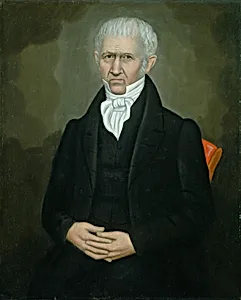
Mr. Pease
c. 1837
Medium
oil on canvas
Dimensions
overall: 89.9 x 74 cm (35 3/8 x 29 1/8 in.) framed: 100.3 x 83.8 x 4.4 cm (39 1/2 x 33 x 1 3/4 in.)
Classification
Painting
Department
CAB
Museum
National Gallery of Art, Washington, D.C.
Credit
Gift of Edgar William and Bernice Chrysler Garbisch
Accession Number
1965.15.1
Rights
Public Domain
Art Historical Context
**Mr. Pease** is a compelling portrait by Erastus Salisbury Field, around 1837 in oil on canvas. Field, a self-taughtant artist from Massachusetts (1805–1900), captured the likeness of his subject—a stern, dignified gentleman likely from New England's merchant class—measuring 89.9 x cm. This work exemplifies early 19th-century American art, a tradition born from a growing demand for affordable portraits among the rising middle class, before photography disrupted the market. Field's naive style shines through in the painting's flat perspective, bold outlines, and vivid colors, hallmarks of folk artists who bypassed formal European training. The subject's direct gaze and simplified background emphasize character over realism, reflecting cultural values of self-reliance and moral uprightness in Jacksonian America. Oil on canvas allowed Field's luminous palette to evoke a sense of permanence, making this intimate depiction both accessible and timeless. Now housed in the National Gallery of Art, Washington, D.C., thanks to the gift of Edgar William and Bernice Chrysler Garbisch—renowned collectors of American folk art—**Mr. Pease** invites visitors to ponder the everyday heroes of antebellum life, preserved in vibrant simplicity. (198 words)
About the Artist
Erastus Salisbury Field · 1805–1900
1805–1900