
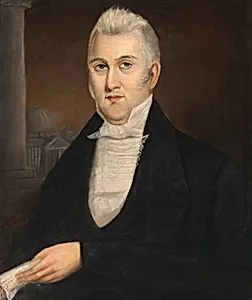
John Middleton Clayton
Medium
Painting
Classification
Painting
Department
Smithsonian Collection
Museum
Smithsonian American Art Museum
Credit
National Portrait Gallery, Smithsonian Institution
Accession Number
NPG.74.3
Rights
Public Domain
Tags
About this artwork
Rose A. Boving, Baltimore; purchased 1973 NPG
Art Historical Context
This striking 1843 portrait by David Acheson Woodward captures John Middleton Clayton, a prominent Delaware statesman, lawyer, and agriculturist who later served as U.S. Secretary of State President Zachary Taylor. Painted when Woodward was just 20 years old, the work reflects the young artist's early skill in portraiture, a genre central to 19th-century American art for immortalizing leaders and preserving national identity. Clayton, depicted with architectural elements like columns and a dome in the background—evoking grandeur and classical ideals—holds a document, symbolizing his legal and political prowess. The painting's historical significance lies in its snapshot of Clayton during a pivotal era of American expansion and debate over slavery. As a Whig senator and diplomat, Clayton championed compromises that shaped the young republic. Acquired from Rose A. Boving in Baltimore by the National Portrait Gallery in 1973, it now resides in the Smithsonian American Art Museum, offering visitors a window into antebellum elite portraiture. Woodward's precise rendering highlights the subject's dignified bearing, blending realism with symbolic motifs to celebrate civic virtue.