
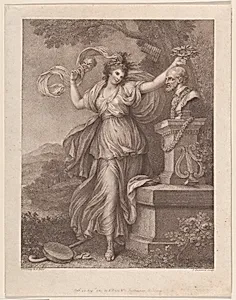
Mrs. Abington as Thalia
Medium
Stipple engraving and etching, printed in brown ink; first state of seven
Dimensions
image: 9 1/4 x 7 1/4 in. (23.5 x 18.4 cm) sheet: 17 1/16 x 8 3/8 in. (43.3 x 21.3 cm)
Classification
Prints
Department
Drawings and Prints
Museum
Metropolitan Museum of Art, New York, NY
Credit
Harris Brisbane Dick Fund, 1917
Accession Number
17.3.1199
Rights
Public Domain
Tags
Art Historical Context
Step into the vibrant world of 18th-century British theater with *Mrs. Abington asalia* (1783), a captivating stipple engraving and etching printed in warm brown ink. This first-state print from a series of seven captures the celebrated actress Frances Abington in the guise of Thalia, the Greek Muse of comedy. Adorned with theatrical masks—a nod to her dramatic prowess—Abington embodies the joy and wit of the stage, her expressive pose drawing from Shakespearean traditions that infused London playhouses with poetic energy. Master engraver Francesco Bartolozzi, renowned for his delicate stipple technique of tiny dots to create subtle tones and textures, collaborated here with miniaturist Richard Cosway (likely the original designer) and Simon Watts. This reproductive print, now in the Metropolitan Museum of Art's Drawings and Prints collection, exemplifies the era's booming print culture, making celebrity portraits accessible to a wide audience. Measuring about 9¼ x 7¼ inches, its intimate scale belies its cultural punch. In 1783, at the peak of Abington's fame, such images celebrated women breaking barriers in the arts, linking classical mythology to Shakespearean revelry. A true gem for theater lovers, it whispers of laughter-filled nights at Drury Lane.
About the Artist
Francesco Bartolozzi|Richard Cosway|Simon Watts|Frances Abington|William Shakespeare · 1727–1815
Francesco Bartolozzi (1727–1815) was an Italian engraver whose most productive period was spent in London, where he became the leading exponent of stipple engraving and a founding member of the Royal Academy. Born in Florence and trained first as a painter before turning to engraving in Venice, he established his reputation in Rome before being recruited by the English Royal Librarian Richard Dalt...