
Mrs. Craik
1850/65
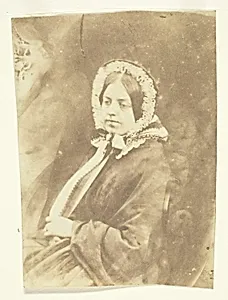
Medium
Calotype
Dimensions
Image/paper: 9.4 × 6.8 cm (3 3/4 × 2 11/16 in.)
Classification
salted paper print
Department
Photography and Media
Museum
Art Institute of Chicago
Accession Number
34928
Rights
Public Domain
Art Historical Context
**Mrs. Craik** (ca. 1850–65) is a delicate portrait captured through the pioneering calotype process, an early form of photography that emerged in the 1840s. Created by an unknown artist, this salted paper print measures just 9.4 × 6.8 cm, inviting close inspection of its intimate scale. The subject, Mrs. Craik, gazes directly at the viewer in a composed, Victorian-era pose, her attire and setting evoking the refined domesticity of mid-19th-century Britain or Europe. The calotype, invented by William Henry Fox Talbot, revolutionized image-making by using a paper negative to produce multiple positive prints on salted paper—sensitized with salt and silver nitrate for a soft, textured glow. Unlike the sharper daguerreotypes, calotypes offered a painterly quality with subtle tonal gradations, bridging art and science. This technique flourished briefly before being eclipsed by faster processes, making surviving examples like this one rare treasures. Housed in the Art Institute of Chicago's Photography and Media department, **Mrs. Craik** highlights photography's role in preserving everyday portraiture during its infancy. It captures a moment when the medium was still experimental, blending technical innovation with the human stories of ordinary lives, reminding us how early photographers immortalized the faces of their time.
About the Artist
Unknown
The artist designated as "Unknown" in our virtual museum's collection exemplifies a poignant chapter in art history: creators whose identities have faded into obscurity despite the enduring power of their work. With only one known artwork attributed to them in our holdings, this figure represents countless anonymous hands that shaped visual culture across centuries. Museums worldwide, including th...