
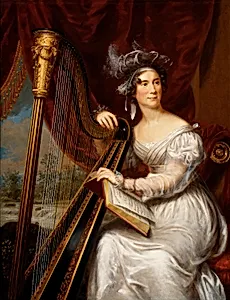
Mrs. John Quincy Adams
ca. 1824
Medium
Painting
Classification
Painting
Department
Smithsonian Collection
Museum
Smithsonian American Art Museum
Credit
Smithsonian American Art Museum, Adams-Clement Collection, gift of Mary Louisa Adams Clement in memory of her mother, Louisa Catherine Adams Clement
Accession Number
1950.6.5
Rights
Public Domain
Tags
About this artwork
Louisa Catherine Johnson was born in England to an American father and British mother. Her father was the first American consul in England after the Revolutionary War, and the elegant Johnson household was a gathering spot for prominent Americans passing through London. John Quincy Adams visited the Johnsons while serving as American minister to Holland. He fell in love with Louisa, and proposed to the twenty-two-year-old beauty only four months after they met. The couple married in 1797 in Lond...
Art Historical Context
This elegant portrait by Charles Bird King captures Louisa Catherine Adams around 1824, shortly before her husband John Quincy Adams assumed the presidency. Born in England to an American father and British mother, Louisa grew up in a cosmopolitan household that hosted visiting diplomats and statesmen. She married the future president in London in 1797 after a brief courtship, and the painting presents her as a poised and cultured First Lady-in-waiting, her refined demeanor reflecting both personal accomplishment and the expectations of her public role. King depicts Louisa seated at a harp, her fingers poised above the strings, dressed in the fashionable attire of the period. The open sheet music bears the title “Oh! Say Not Woman’s Heart Is Bought,” a detail the artist carefully reproduced to underscore themes of genuine affection over material considerations. The inclusion of the harp, long associated with feminine grace and musical education, highlights Louisa’s talents while quietly affirming her intellectual and emotional depth. Painted with King’s characteristic precision, the work exemplifies early nineteenth-century American portraiture’s blend of personal likeness and symbolic statement. Today it resides in the Smithsonian American Art Museum’s Adams-Clement Collection, offering visitors a vivid glimpse into the life of one of the nation’s most accomplished early First Ladies.