
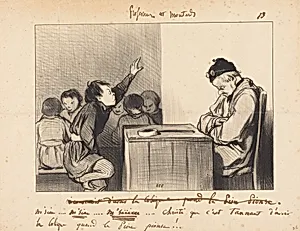
M'sieu... que c'est tannant d'avoir la colique quand...
1846
Medium
lithograph
Classification
Department
CG-E
Museum
National Gallery of Art, Washington, D.C.
Credit
Rosenwald Collection
Accession Number
1946.21.273
Rights
Public Domain
Art Historical Context
Honoré Daumier, a masterful French caricaturist of the 19th century, created *M'sieu... que c'est tannant d'avoir la colique quand...* in 1846 as a lithograph, part of his prolific output for satirical journals like *Le Charivari*. During the July Monarchy under King Louis-Philippe, Daumier skewered the pretensions of the bourgeoisie and political elite through exaggerated, empathetic depictions of everyday life. This print captures a moment of comic misery—likely a hapless figure lamenting the agony of colic (severe abdominal pain)—highlighting the artist's keen eye for human vulnerability and social absurdities. Lithography, Daumier's preferred medium, revolutionized printmaking by allowing artists to draw directly on stone for reproducible, expressive images. His bold lines, dynamic compositions, and facial distortions conveyed volumes of satire with remarkable economy, making his works accessible to a wide audience via inexpensive newspapers. This technique amplified Daumier's role as a "people's artist," critiquing class divides and urban woes in Second Empire France. Housed in the National Gallery of Art's Rosenwald Collection, this piece exemplifies Daumier's enduring legacy: over 4,000 lithographs that blend humor with sharp social commentary, influencing later cartoonists and offering a vivid window into 1840s Parisian life. Visitors will delight in its timeless wit—proof that some discomforts are universally "tannant" (annoying)!
About the Artist
Honoré Daumier · 1810–1879
Honoré-Victorin Daumier (1808-1879) was a prolific French printmaker, caricaturist, painter, and sculptor whose works offered incisive commentary on the social and political life of 19th-century France. Known as the 'Michelangelo of Caricature,' Daumier produced over 4,000 lithographs, 500 paintings, 1,000 drawings, and 100 sculptures during his lifetime. His biting political satire led to his imp...