
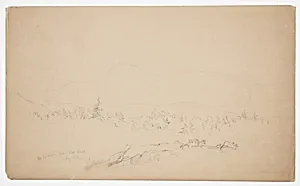
Mt. Katahdin from the East, Maine
August 1852
Classification
landscapes
Department
Smithsonian Collection
Museum
Smithsonian American Art Museum
Credit
Gift of Louis P. Church
Accession Number
1917-4-634
Rights
Public Domain
About this artwork
Research in Progress
Art Historical Context
Frederic Edwin Church, a leading figure of the Hudson River School, the majestic Mt. Katahdin from east in this 1852 landscape, painted during a summer expedition to Maine. As Thomas Cole's prized pupil, Church embodied the Romantic ideal of America's untamed wilderness, portraying nature's sublime power to inspire awe and national pride. Completed at age 26, this work reflects his early mastery in depicting vast, luminous vistas that celebrated the young nation's natural wonders amid rapid industrialization. Church's landscapes often featured meticulous detail and atmospheric light, evoking a spiritual connection to the divine in the everyday American scene. Mt. Katahdin, Maine's rugged highest peak, symbolized frontier exploration and Manifest Destiny, themes resonant in mid-19th-century art. Though the medium remains unidentified, its classification as a landscape underscores Church's commitment to realism infused with emotion. Now in the Smithsonian American Art Museum as a gift from Louis P. Church, this piece invites visitors to ponder the enduring allure of wild places. Research continues to uncover more about its creation, but it stands as a testament to Church's visionary gaze on America's heartland.