
Mug
ca. 1836–ca. 1841
Medium
Earthenware, transfer-printed
Dimensions
H. 2 1/2 in. (6.4 cm); Diam. 3 1/2 in. (8.9 cm)
Classification
Mug
Culture
British (American market)
Department
The American Wing
Museum
Metropolitan Museum of Art, New York, NY
Credit
Gift of Mrs. Lydia Bond Powel, 1964
Accession Number
64.84
Rights
Public Domain
Tags
Art Historical Context
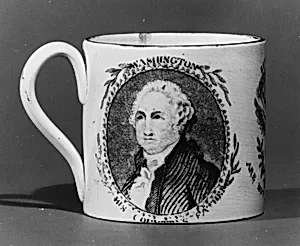
This charming earthenware mug, crafted by the British firm Ralph Hall & Son around 1836–1841, exemplifies transatlantic trade in decorative ceramics tailored for the American market. Measuring just 2½ inches high and 3½ inches diameter, its petite scale made it ideal for everyday use—perhaps as a child's cup or a novelty item—while its transfer-printed decoration elevated it to a keepsake of national pride. Produced in Staffordshire, England, these mugs flooded U.S. households during a time of growing American patriotism, blending British manufacturing prowess with Yankee iconography. The standout feature is the transfer-printed portrait of George Washington, a ubiquitous symbol of the young republic's founding father. Transfer-printing, a revolutionary 19th-century technique, involved etching designs onto copper plates, inking them onto tissue paper, and pressing them onto unfired earthenware before glazing and firing. This method allowed for intricate, multicolored imagery at low cost, democratizing fine decoration on humble pottery and fueling the popularity of patriotic tableware. Housed in The Metropolitan Museum of Art's American Wing, this mug—gifted by Mrs. Lydia Bond Powel in 1964—offers a tangible glimpse into antebellum consumer culture. It reflects how Britons catered to Americans' reverence for Washington, bridging commerce and commemoration in objects that graced humble homes.